

Every year someone announces that WordPress is dead. For most of the last decade it was easy to ignore, because the numbers kept going the other way. In 2026 that changed. For the first time in ten years, the people saying it have a chart to point at.
So is AI killing WordPress? The honest answer is more interesting than yes or no. WordPress is shrinking a little, something is clearly growing in its place, and it isn’t the competitor most people would guess.
Here is what the data actually says, and what it means if you build or look after websites for clients.
The numbers, without the spin
The most widely quoted source is W3Techs, which checks the technology behind well over 20 million websites and updates its figures daily. On 20 October 2026 it put WordPress at 39.6% of all websites, and 58.3% of the sites that use any content management system.
For context, its yearly history shows WordPress at 23.3% in January 2015. It climbed almost every year, reached about 43% in 2022, and peaked at 43.6% in January 2025. Then it started to slide: 43.0% at the start of this year, 39.6% today.
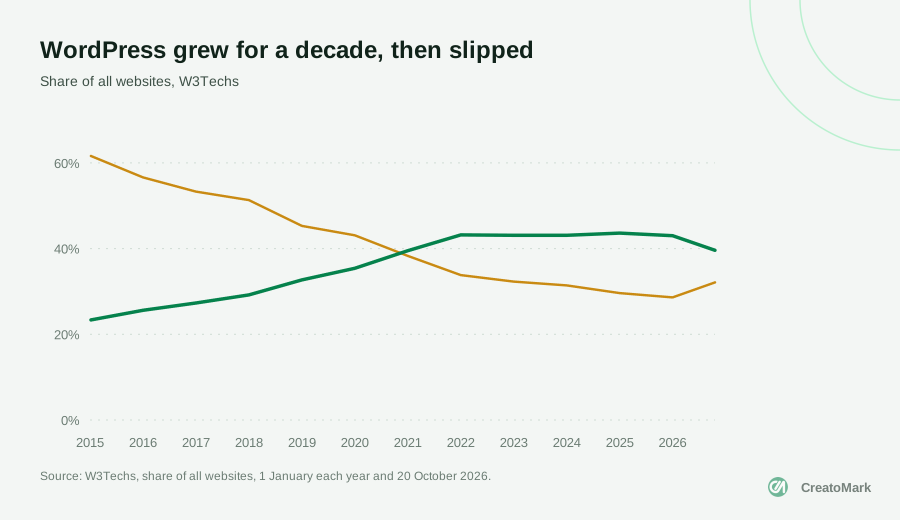
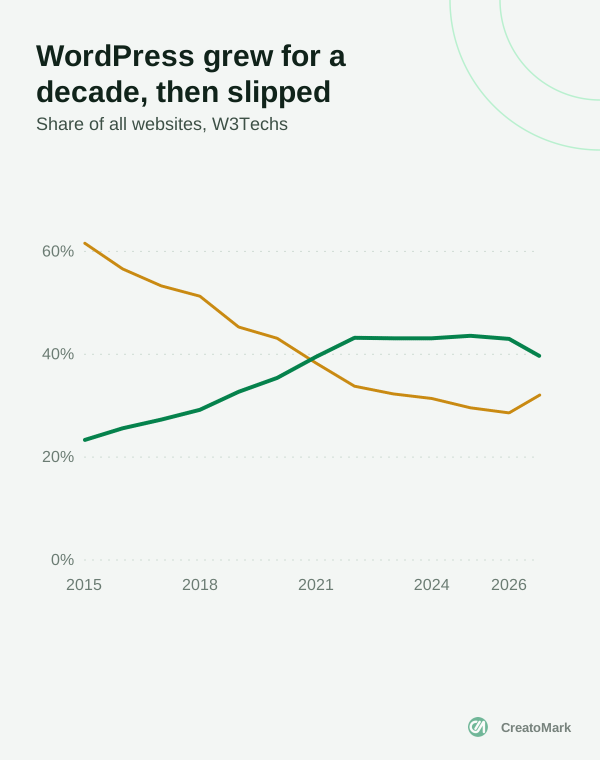
That drop is real, and it isn’t one tool’s quirk. The HTTP Archive Web Almanac, which measures the web a completely different way, also found WordPress slightly down from its 2024 peak, while still running roughly 64% of the sites that use a CMS. Search Engine Journal tracked the slide month by month through the first half of 2026.
One thing to keep in mind: these are percentages of a web that keeps growing. A falling share doesn’t necessarily mean fewer WordPress sites exist. It means other kinds of sites are being added faster.
Where did the share go?
This is the part most “WordPress is dying” posts skip. If WordPress were losing customers to Wix or Squarespace, you’d expect their share to rise by roughly what WordPress lost. It didn’t.
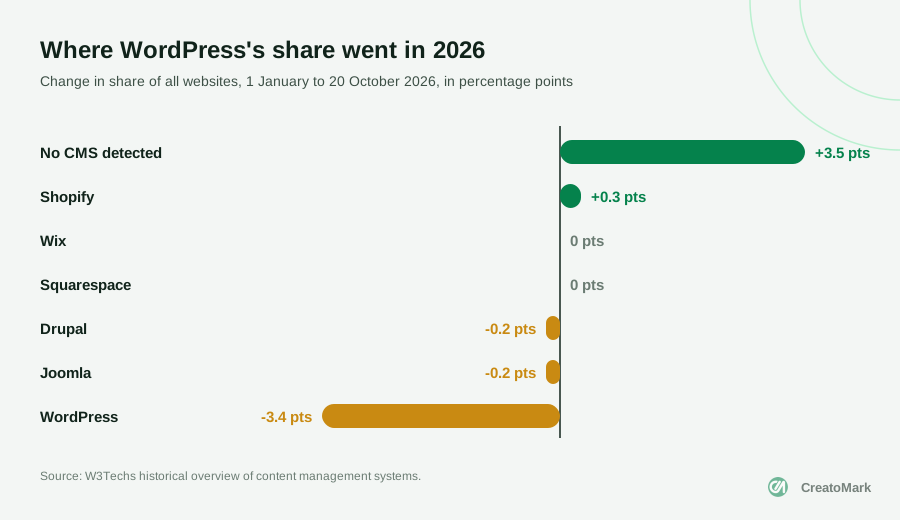
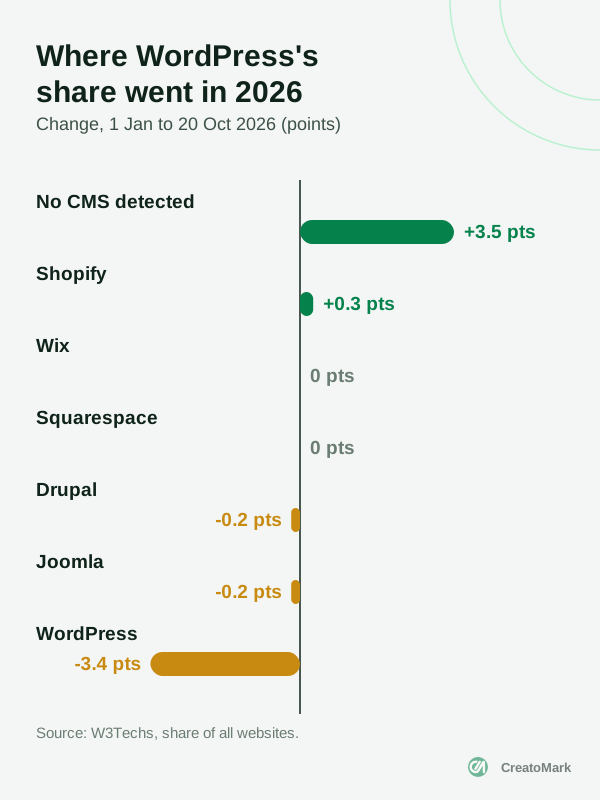
Between January and October 2026, W3Techs shows WordPress down 3.4 points. Wix and Squarespace didn’t move. Shopify gained 0.3. The big winner was a category that isn’t a product at all: websites with no content management system detected, up 3.5 points.
W3Techs doesn’t say what those sites are, so be careful with any confident explanation, including ours. But one obvious candidate fits the shape of the data very well.
The rise of the AI app builder
Tools like Lovable, Bolt and v0 don’t install a CMS. You describe what you want and they write the code: usually a modern JavaScript app, hosted on the tool’s own platform. To a scanner like W3Techs, that looks exactly like a site with no CMS.
And these tools are not small anymore. Lovable’s co-founder said in September 2026 that the company had passed an annual run rate of $600 million, with “close to a billion visits per month” to apps built on it. Even Wix, the builder everyone used to worry about, now puts its own AI app builder first when it explains its growth: its second quarter 2026 results reported revenue up 15%, “driven by strong Base44 performance and continued core Wix growth”.
It’s probably not the whole story. Search Engine Journal points out that the decline began in the quarter after the public dispute between WordPress co-founder Matt Mullenweg and the hosting company WP Engine. That’s a correlation, not proof, but it’s a fair one to mention.
WordPress didn’t lose this year’s share to another website builder. It lost it to sites that don’t use a CMS at all.
So why is “dead” the wrong word?
Because 39.6% of the web is still an enormous number. Roughly four in every ten websites run on WordPress, more than every other CMS on the W3Techs list put together. The free plugin directory lists more than 72,000 plugins today. No AI builder has anything close to that ecosystem of themes, plugins, hosts and people who know how to use them.
WordPress is also adapting rather than standing still. Version 7.0 built AI connections into the core software, so plugins can use any AI provider a site owner chooses. We explained what that means in what WordPress 7.0 changed for agencies.
The more useful question isn’t “is WordPress dead?” but “what is each kind of tool actually good for?”
Where AI builders genuinely win
It would be silly to pretend these tools aren’t impressive. In our experience they’re excellent for:
- Prototypes and demos. Showing a client an idea in an afternoon instead of a week.
- Internal tools. Small apps a team uses every day, where nobody needs to edit content.
- One-off landing pages for a launch or a campaign that will be gone in three months.
- Founders testing an idea before they spend real money on it.
The trouble starts later, when the prototype becomes the business. Content needs updating, someone non-technical needs to edit a page, the SEO matters, and the person who prompted it into existence has moved on. We see more of these every month, which is why we wrote what breaks when AI-built apps need to grow.
Where WordPress still wins
WordPress earns its place when a site has to live, change and grow for years:
- Content and SEO. Blogs, resource libraries and service pages that get edited every week.
- Teams with several editors, each with the right role and permissions.
- Shops, memberships and bookings, with mature plugins for each.
- Ownership. The software is open source, you can move hosts any time, and your content isn’t locked inside one company’s platform.
What to tell a client who asks

Sooner or later a client will forward you a headline and ask whether they should leave WordPress. Before you answer, ask them four things:
- Who will edit the site, and how often? If it’s a marketing team posting every week, they need a real editor, not a prompt box.
- How much of your business comes from search? Sites that live on organic traffic need content, structure and technical SEO they control.
- What does it need to connect to? Payments, CRM, bookings, email. Check that each one is supported and maintained.
- Who looks after it in two years? Every site needs updates and fixes. Decide now who does that work and how it’s paid for.
Sometimes the answers point to an AI builder or a simple website builder like Webflow or Wix, and that’s fine. More often, for businesses that rely on their website to bring in work, they point back to WordPress. If a client has already built something with AI and wants it to grow up, here’s what to do when a client builds a site with an AI tool.
What this means for agencies
The agencies that will do well aren’t the ones defending WordPress no matter what. They’re the ones who can say, calmly, “here’s what each option costs you over three years,” and then deliver whichever one is right.
That means being comfortable with AI builders for the jobs they’re good at, and being the people clients call when an AI-built site needs a proper home. We help agencies with both: turning vibe-coded prototypes into production sites, and WordPress development for the sites that need to last. And when clients start building their own sites with AI, that’s a change to work with, not a threat to fear. We wrote about how agencies still win when that happens.
The bottom line
WordPress isn’t dying. It is losing a little ground for the first time in a decade, mostly to a new kind of site that skips the CMS entirely. Some of those sites will stay small and simple. Some will grow, and will need what WordPress has always been good at: content, editors, plugins and an owner who controls their own site.
Watch the numbers, keep an open mind about the tools, and keep the conversation with clients focused on what their site needs to do. If you’d like a second opinion on a client’s platform choice, book a call and we’ll talk it through.