


You’ve just closed two new website projects. Great news. Then the familiar thought creeps in: who’s actually going to build them?
Your developer is already juggling three sites. You could squeeze the new work in with a few late nights. You could turn one project down. Or you could finally make the hire you’ve been putting off for months.
Before you post that job ad, let’s do the math together. Not the salary on the ad, the real number. Then let’s look at the other option, and, just as important, when hiring is honestly the better call.
The salary is only the starting point
In the US, the median web developer earns $90,930 a year, according to the Bureau of Labor Statistics. That’s the middle of the market, not a senior hire, and plenty of agencies pay more to get someone good.
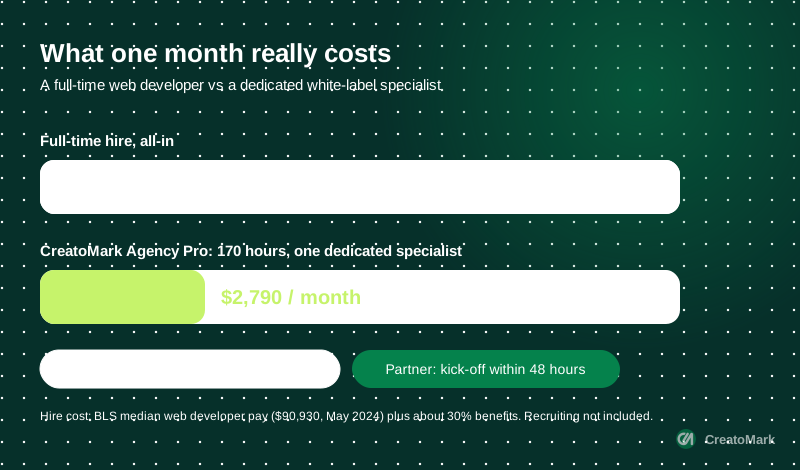
But salary isn’t what an employee costs you. Benefits, payroll taxes, paid leave and insurance add up fast. BLS data shows benefits make up about 30% of total compensation for private employers. Run that against a $90,930 salary and you’re closer to $129,700 a year, or about $10,800 a month.
And we haven’t counted the costs that never show up on payroll:
- Recruiting time. SHRM’s 2025 benchmarks put the average time to fill a role at about a month and a half. That’s six weeks of reading CVs, running interviews and setting tests, usually by you.
- Onboarding. Even a great developer needs a few weeks to learn your stack, your standards and how your clients like things done.
- Tools and equipment. A laptop, software licences, plugin and hosting accounts. Small on their own, real when you add them up.
- Management. Someone has to plan their week, review their code and answer their questions. In most small agencies, that someone is you.
None of this means hiring is a bad idea. It means the number you compare against should be the full one.
The cost nobody budgets for: quiet months
Here’s the part that catches most agency owners out. Client work doesn’t arrive in a steady stream. It comes in waves.
In a busy month, your new developer is flat out and worth every penny. In a quiet month, you’re still paying the full salary while they tidy old projects and wait for the next brief. A salary is a fixed cost. Your revenue isn’t.
That gap between what you pay for and what you actually use is where agency margins quietly disappear. It’s also why so many owners end up saying the same thing: “We hired to grow, and somehow we’re making less.”
A salary is a fixed cost. Your pipeline isn’t. The trick is matching one to the other.
What a white-label partner actually costs
A white-label partner works differently. Instead of paying for a seat, you pay for capacity, and you scale it up or down with your pipeline. It’s also the simplest way to scale your agency without burning out.
To give you a real comparison, here’s how our own plans work at CreatoMark. On our Agency Pro plan, you get 170 hours a month and one dedicated specialist working on your projects every working day, for $2,790 a month. Need more? The Advance plan gives you 285 hours and two or more dedicated team members for $3,990. You can compare every plan on our pricing table.
Those hours aren’t locked to one skill, either. The same plan can cover a WordPress build this week, a landing page next week and a speed fix after that. Try finding one hire who does all three well.
A few other things change when you partner instead of hire:
- You start in days. Most of our partners kick off within 48 hours of the first call, not six weeks.
- Someone else handles the management. A project manager plans the work, and a senior reviewer checks everything before it reaches you.
- No long contract. Plans renew monthly, so a quiet quarter doesn’t leave you stuck with costs you can’t use.
- Your brand stays front and centre. Everything is delivered white-label, so your clients only ever see your agency.
Hiring vs partnering, side by side
| Full-time hire | White-label partner | |
|---|---|---|
| Monthly cost | About $10,800 all-in (median US developer) | From $690, or $2,790 for a dedicated specialist |
| Time to start | About 6 weeks to fill the role, plus onboarding | Usually within 48 hours |
| Skills covered | One person’s skill set | Development, design, SEO, ads and more from one plan |
| Quiet months | Full salary, whatever the workload | Scale your plan down |
| Management | Mostly on you | Project manager and QA included |
| Commitment | Employment contract and notice periods | Month-to-month |
Figures are for comparison only. Your real salary costs depend on where you hire and how senior the role is.
When hiring is genuinely the better choice
We’d be doing you a disservice if we said a partner always wins. It doesn’t. Hiring makes more sense when:
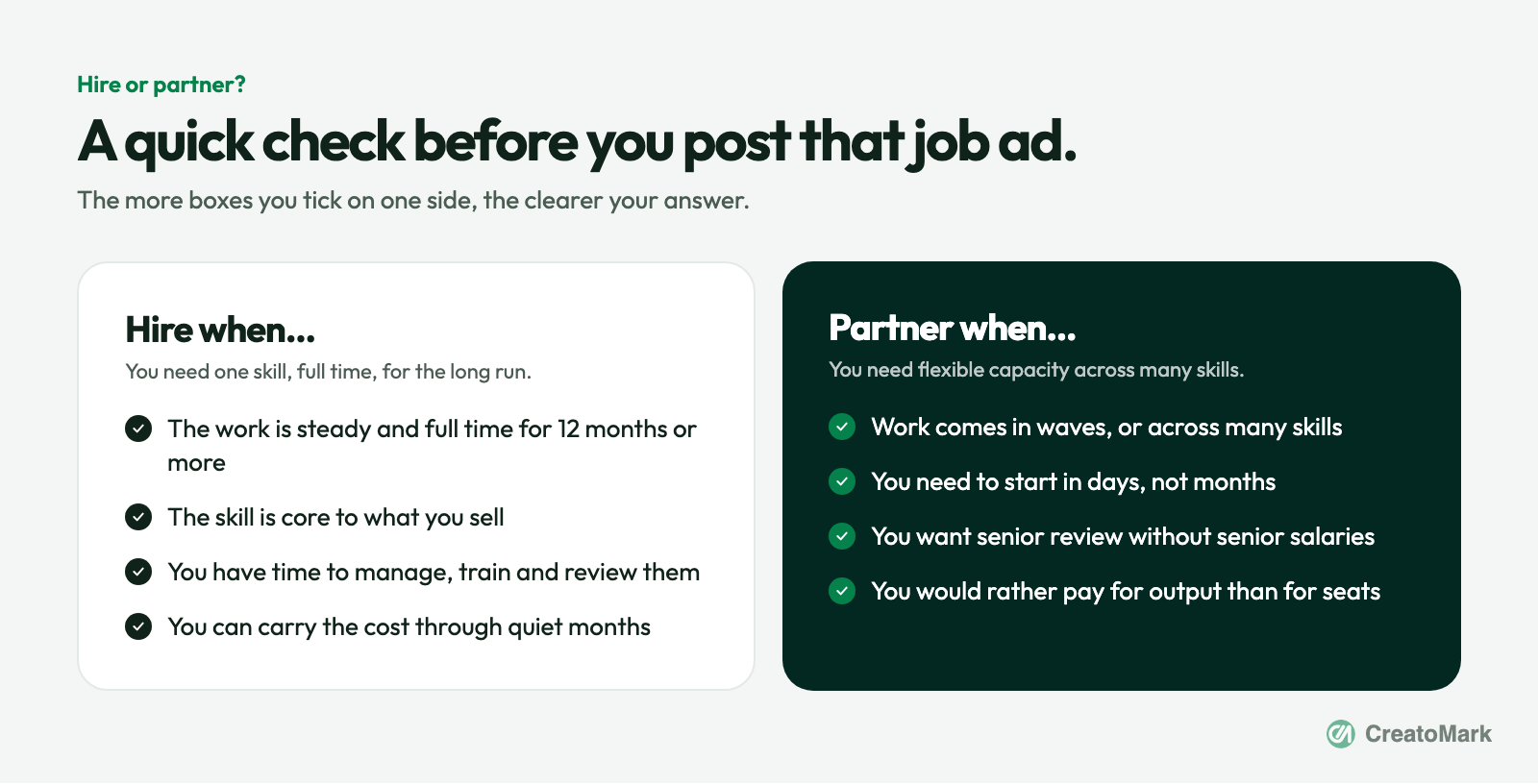
- The work is steady and full time, and you can see it staying that way for at least a year.
- The skill is core to what you sell. If custom development is your product, you probably want that knowledge inside the building.
- You have time to manage and mentor. A new hire needs someone who can review their work and help them grow.
- You can carry the cost through a slow patch without it keeping you up at night.
If all four are true, hire. You’ll be building something valuable. If one or two make you hesitate, keep reading.
The middle path most growing agencies take
In practice, it isn’t either-or. Most agencies we work with land somewhere in between:
- Keep a small core team for strategy, client relationships and the work that makes you different.
- Use a partner for overflow and specialist work, like big builds, Shopify stores, technical SEO or AI chatbots.
- Hire when the numbers prove it. If you’ve used a partner’s full capacity for six months straight, that’s strong evidence a hire will pay off.
This way you grow on proof, not hope. You never hire into a quiet patch, and you never turn down a good project because the team is full.
How to run the numbers for your own agency
Grab your last six months of project data and answer four questions:
- How many hours of development and design did you actually sell each month? Not your busiest month, the average.
- How much did those hours swing between your quietest and busiest month?
- What would a hire cost you all-in, using the 30% rule above?
- What would the same hours cost from a partner, including the months you’d scale down?
If your hours are high and steady, a hire will probably win. If they swing a lot, or spread across lots of different skills, a partner will almost always come out ahead.
Want a second opinion on your numbers? Book a 30-minute call and we’ll go through them with you, honestly, even if the answer is “go hire someone”. Book a growth call
The bottom line
Hiring isn’t wrong, and partnering isn’t a shortcut. They solve different problems. A hire gives you a fixed amount of one skill. A partner gives you flexible capacity across many skills.
You don’t need to choose forever. You need to choose for now, and keep the next step open.
If a partner sounds like the right fit, our guide on how to choose a white-label partner covers the 12 questions to ask before you hand over a single client. And if you’d like to see how we work, start with our White Label Partner page.