


Handing a client project to an outside team is a big moment. You’ve spent months, maybe years, earning that client’s trust. Now someone they’ll never meet is about to build the thing they’ll judge you on.
So it makes sense to be picky. The good news? You don’t need a 40-page vendor assessment. You need the right questions, asked early, and the confidence to walk away if the answers feel off.
Here are the 12 we’d ask if we were in your shoes. We’ve grouped them into four areas: people, protection, process and commitment.
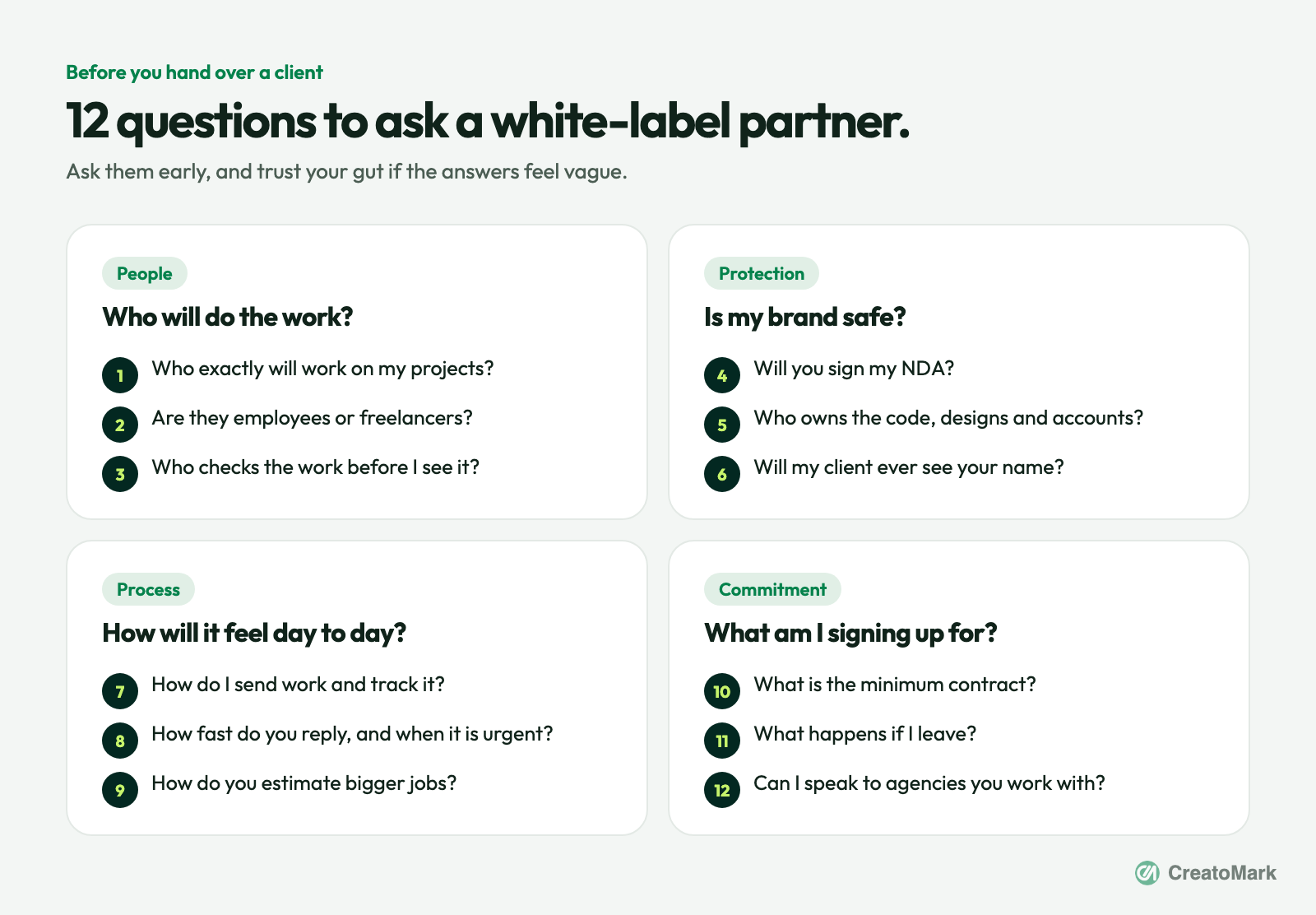
People: who will actually do the work?
1. Who exactly will work on my projects?
This is the question that matters most, and the one vague partners dodge. Some firms sell you a senior team on the sales call, then pass the work to juniors, or worse, to freelancers you’ve never heard of.
Ask to meet the people, or at least see their roles and experience. A good partner will happily introduce your project manager and the lead on your account.
2. Are they employees or freelancers?
There’s nothing wrong with freelancers in general. But if your partner subcontracts your work, you’re now two steps away from the person writing the code, and your client’s data is in more hands than you agreed to.
Look for a partner whose own team does the work. Ask it straight: “Will anyone outside your company touch my projects?”
3. Who checks the work before I see it?
Mistakes happen. What matters is whether they reach you, or your client. Ask what checks happen before delivery: code review, testing on different browsers and devices, a second pair of eyes on the design.
At CreatoMark, every deliverable is reviewed by someone with at least five years of experience before it lands in your inbox. Whoever you choose, expect a clear answer like that, not “our developers are very careful”.
Protection: will your brand and your clients be safe?
4. Will you sign my NDA?
The answer should be an instant yes, before you share a single brief. If a partner hesitates, or pushes their own one-sided agreement instead, treat that as a warning.
5. Who owns the code, designs and accounts?
You do. Or more precisely, you and your client do. Check that everything is yours once it’s paid for, and that domains, hosting and ad accounts sit in accounts you control. A partner who keeps the keys can hold your client hostage if things go wrong.
6. Will my client ever see your name?
True white-label means no credits in the footer, no hidden links in the code, no emails from their domain and no contact with your client unless you ask for it. Ask how they handle staging links, reports and support emails too, because that’s where names slip through.
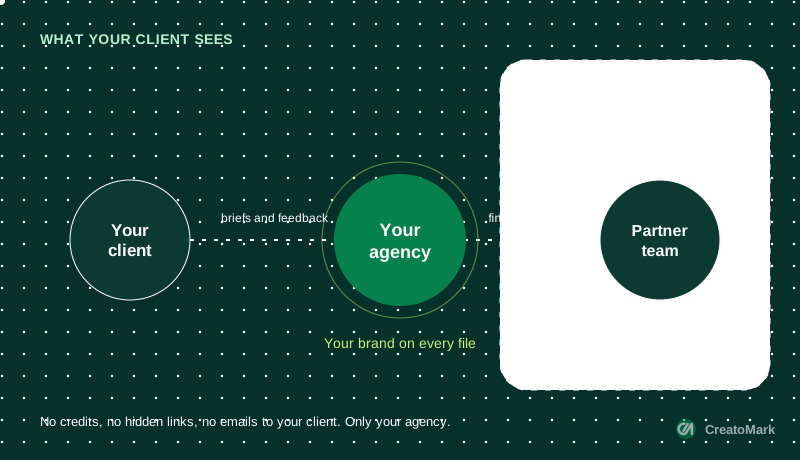
Process: how will it feel day to day?
7. How do I send work and track progress?
Email threads get messy fast. A good partner gives you one place to send requests, share files, see progress and approve work. Ask for a quick tour of their portal or project board before you sign anything.
8. How fast do you reply, and what happens when something is urgent?
You want real numbers, not “we’re very responsive”. Ask how quickly they reply to a new request, and what happens when a client’s site goes down on a Friday afternoon. Our own reply times are on our Support page, set by plan, so partners always know what to expect.
9. How do you estimate bigger jobs?
Surprise invoices destroy trust faster than anything. Ask how they scope work. Do you get an estimate before they start? What happens if the job grows halfway through? The best partners flag changes early, before the hours are spent.
Commitment: what are you signing up for?
10. What is the minimum contract?
Long lock-ins make little sense in a business where your workload changes every month. Look for month-to-month plans you can scale up or down as your pipeline moves.
11. What happens if I leave?
It feels odd to ask about the exit on day one, but it’s one of the smartest questions on this list. How do they hand over files, code, logins and documentation? How much notice do they need? Read the exit terms before you sign the entry.
12. Can I speak to agencies you already work with?
Ask for a reference from an agency that uses them for white-label work, not just a direct client. Then ask that agency the awkward questions. Have they ever contacted your clients? Did deadlines slip? How did they handle a mistake?
Green flags and red flags at a glance
| Green flag | Red flag |
|---|---|
| Introduces you to the people doing the work | Won’t say who works on your projects |
| Signs your NDA before seeing any brief | Pushes their own one-sided agreement |
| Everything is delivered under your brand | Credits, links or emails with their name |
| Clear reply times and a portal to track work | “We’re very responsive”, with no numbers |
| Estimates bigger jobs before starting | Surprise invoices after the work is done |
| Month-to-month plans and a clear exit process | Long lock-in contracts |
Start small before you go all in
Even with great answers, nothing beats seeing real work. Before you hand over your biggest client, start with something lower risk:
- A small internal task, like an update to your own agency website.
- A self-contained client job, such as a landing page or a speed fix.
- A short trial of one month on a smaller plan.
Watch how they communicate, how they take feedback and whether the work arrives when they said it would. You’ll learn more from one small project than from five sales calls.
How we answer these questions
If you’re considering CreatoMark, here’s the short version. Our own team does the work, with no freelancers and no re-outsourcing. We sign your NDA before we see a project. Everything goes out under your brand, you own all of it, and plans renew monthly with no lock-in.
You can read the details on our White Label Partner page, see how support works on our Support page, or meet the people behind the work on our About page.
Still deciding between a partner and a new hire? Read our breakdown of what it really costs to add a developer to your agency.
Whoever you choose, ask all 12 questions. A good partner will be glad you did.