


You finally take a week off. On day two your phone lights up: a client can’t find the staging link, a developer needs a login, and nobody is sure whether the homepage change was approved. You fix it all from your hotel room, and you wonder whether you really run a business or just a very demanding job.
Running an agency remotely isn’t about where people sit. It’s about whether the work can move without waiting for you. This guide covers the five systems that make that possible, what the research says about remote and hybrid teams, and how to test whether your agency is ready.
In this article
Remote work works, when it’s designed
The best evidence we have is good news for remote and hybrid agencies. The question is no longer whether it can work, but how you set it up:
1/3
Fewer resignations among hybrid staff, with no drop in performance
Nature, 2024, trial of 1,612 staff
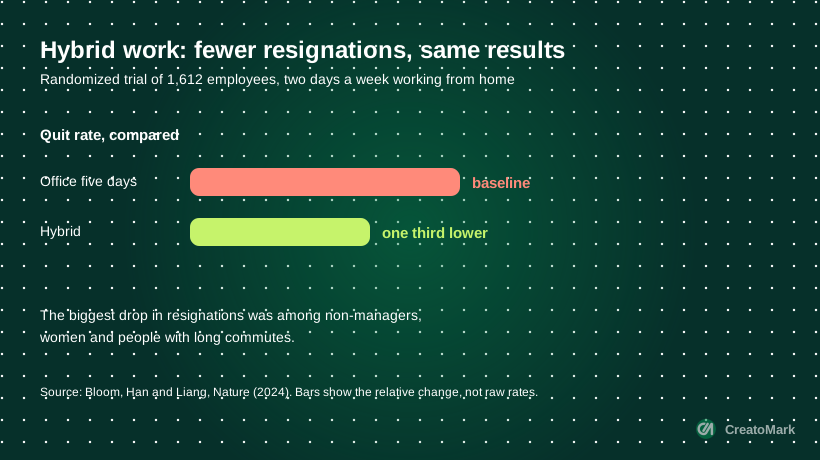
In one of the most careful studies so far, published in Nature in 2024, economists Nicholas Bloom, Ruobing Han and James Liang randomly assigned 1,612 employees at a large company to either five office days or a hybrid schedule with two days at home. Over the next two years, hybrid workers quit about a third less often, and there was no difference in performance grades or promotions.
For an agency, that matters twice. Losing a good designer or developer costs you months of recruiting and training, and clients notice when the person who knew their account leaves. Flexibility is one of the cheapest retention tools you have.
The real problem: you are the hub
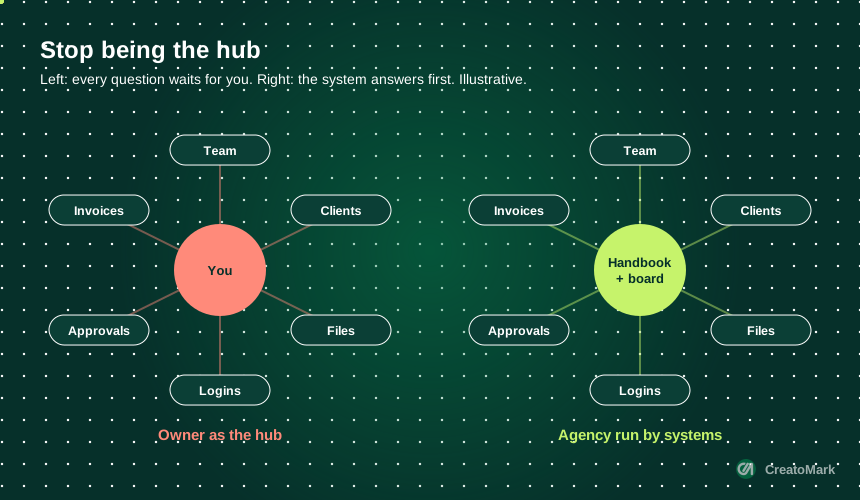
In an office, being the hub feels manageable: people lean over and ask. Remotely, every question becomes a message, and every message waits for you. Atlassian’s State of Teams 2025 survey of 12,000 knowledge workers found teams spend more than a quarter of their workweek just searching for information.
In an agency, that searching sounds like “where’s the brand guide?”, “what did the client approve?” and “who has the hosting login?”. If the answer lives in your head or your inbox, the team waits, and you never get a day off.
A handbook and a project board where every process, login and decision can be found without asking.
Written updates instead of meetings, so people in different time zones can move without waiting.
Every client, project and task has exactly one person responsible, and everyone knows who it is.
The same few check-ins every week, so nothing depends on someone remembering to ask.
Checklists before anything reaches a client, so quality doesn’t depend on you reviewing everything.
One channel and one contact per client, with set reply times, so clients never chase your team.
System 1: one place for every answer
Start with a handbook. It doesn’t need to be beautiful. A shared doc or wiki with these pages covers most of what your team asks you every week:
| Page | What goes in it |
|---|---|
| Client profiles | Contacts, brand guides, tone, approved decisions, links to staging and live sites |
| Service checklists | Step-by-step process for each service you sell: a website build, a care plan month, an SEO audit |
| Access | Which password manager vault holds what. Never paste logins into chat |
| How we work | Working hours, reply times, how to ask for help, how to hand work over |
| Decision log | Short notes on decisions and why, so nobody has to ask twice |
The rule that makes it work: when someone asks you a question, answer it by writing or updating the handbook page, then send the link. After a few weeks, most questions answer themselves.
System 2: async by default, meetings by exception
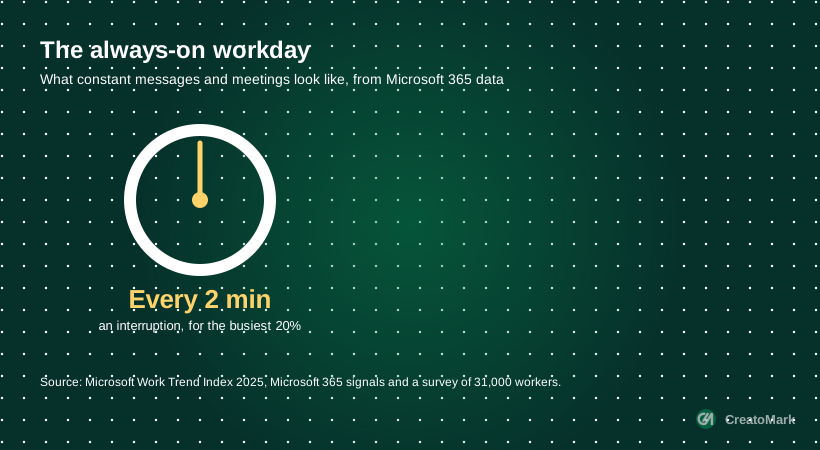
Remote work without rules turns into an always-on workday. Microsoft’s Work Trend Index 2025 found the most interrupted employees are pinged every two minutes during the workday, the average worker gets 117 emails a day, and meetings that start after 8 pm are up 16% year on year.
Async means work moves through written updates that people read when they’re ready, not through calls that need everyone online at once. It matters even more when your team spans time zones, like ours does between the US and Bangladesh.
Needs a meeting
Works async
System 3: one owner for everything
Remote teams rarely fail because people don’t work hard. They fail because two people each think the other one is handling it. Give every client, project and task exactly one owner, written on the project board, not agreed in a call.
| Item | Owner | What they own |
|---|---|---|
| Client account | Account lead | Relationship, scope, approvals, monthly report |
| Project | Project lead | Timeline, task list, handover between people |
| Task | One team member | Doing it, and saying early if it will be late |
| Quality check | A second person | Checking against the checklist before delivery |
In a small agency, one person may own several of these. That’s fine, as long as it is written down and nobody, including you, has to guess.
System 4: a weekly rhythm
A rhythm replaces “checking in” with a schedule everyone can rely on. Here’s a simple one that works for teams of 3 to 15 people:
01
Monday: plan the week
Each person writes their top priorities on the board. You check your agency numbers, as in our guide to the 7 numbers to check every week.
02
Daily: a written check-in
Three lines each: done yesterday, doing today, anything blocking. Five minutes to write, two to read.
03
Midweek: one short call
A 30-minute team call for the things that really need a conversation, with an agenda written in advance.
04
Friday: show and close
Share what shipped, update client reports, and move unfinished tasks with an honest new date.
System 5: quality gates that don’t need you
The biggest fear of a remote owner is that quality slips when they stop checking everything. The fix is to write your standards down so another person can check against them.
A pre-delivery checklist for a website update
Clear standards also make it easier to prove your value to clients every month, because the checklist doubles as a record of what was done.
Keep remote people connected
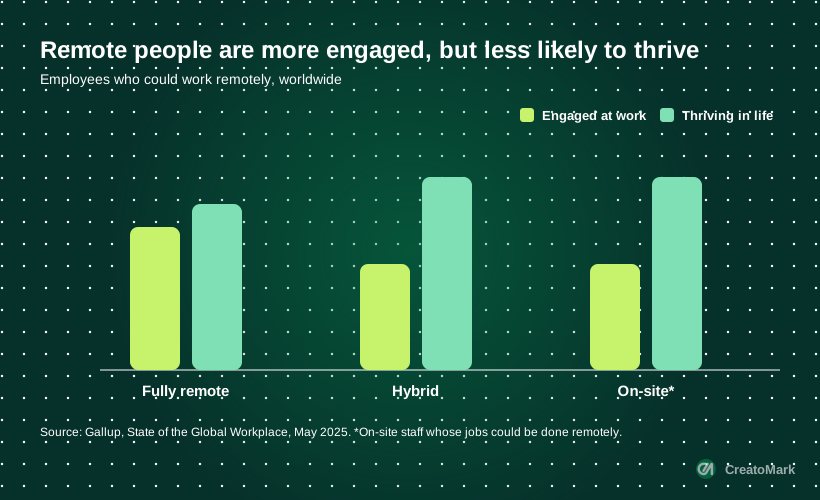
Gallup’s 2025 data shows the other side of remote work. Fully remote employees were the most engaged group at 31%, but only 36% were thriving in life overall, against 42% of hybrid workers. Gallup links this to isolation and recommends that leaders keep the freedom of remote work while deliberately encouraging social contact.

A place for wins, photos and small talk, with no work allowed. It replaces the office kitchen.
Twenty minutes every two weeks with each person, about them, not about tasks.
A team day or retreat once or twice a year, if you can, does more than months of calls.
Agree on hours and reply times, and keep to them yourself. Teams copy what the owner does.
The one-week test
Here’s how to find out whether your agency can run without you in the room. Plan a week where you are unavailable for delivery, and keep a list of every time someone needs you.
Still owner-dependent
Runs on systems
Every item on your list is a page to write, an owner to name or a checklist to create. Fix them one at a time, then run the test again.
Add capacity without adding management
Once your systems exist, adding people gets easier, including people outside your company. A white-label partner plugs into the same briefs and checklists and delivers under your brand, without you managing another hire. We compare the costs in white-label vs hiring, and cover what to ask before you hand over a client in how to choose a white-label partner.
CreatoMark is a hybrid team ourselves, with an office in Bangladesh and remote members, working with agencies in other time zones every day. Our WordPress development and website care plans run on exactly these systems, which is how we help agencies scale without burning out.
Want an agency that runs while you’re away? Book a growth call and we’ll look at which work a partner could take on, or see our plans on the pricing table.
The bottom line
Remote agencies don’t run on trust alone, and they don’t run on more meetings. They run on a handful of simple systems: one place for answers, written updates, clear owners, a weekly rhythm and quality checks that don’t need you.
Build them one at a time. The first time you take a real week off and come back to finished work, you’ll know it worked.