


Your team is busy. Clients are happy. Revenue is the best it has ever been. And yet, when you look at the bank account at the end of the quarter, there’s far less left than all that work should have produced.
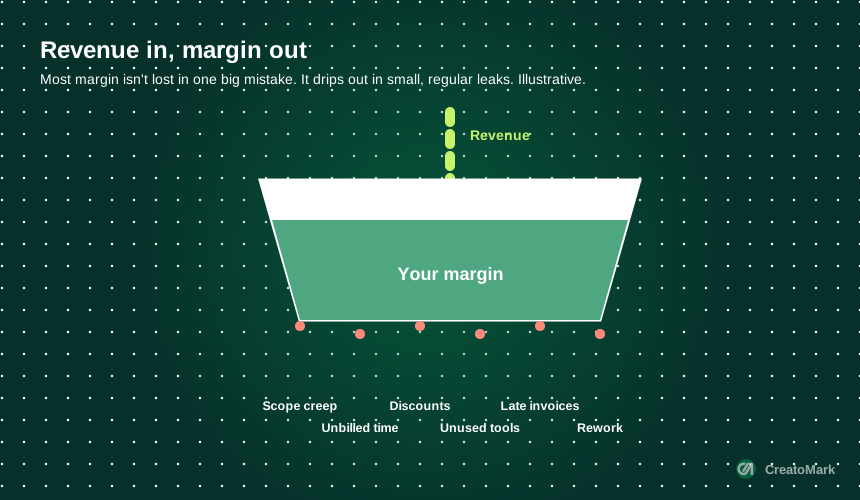
That gap is rarely one big mistake. It’s a handful of small, regular leaks: an extra revision here, an untracked hour there, a discount to win a deal, a tool nobody uses. Each one feels too small to matter. Together, they decide whether your agency makes real money.
In this article
First, know what healthy looks like
Before hunting for leaks, you need a baseline. Agency consultancy Parakeeto suggests these benchmarks, based on agency gross income (revenue minus pass-through costs such as ad spend):
50%+
Delivery margin across the whole agency
Parakeeto benchmark
20 to 30%
Overhead: admin, sales, marketing and premises
Parakeeto benchmark
10 to 15%
Operating margin most agencies reach
Parakeeto, with 25% as a target
If your delivery margin is well under 50%, at least one of the leaks below is open. Our guide to the 7 numbers to check every week shows how to calculate it per client.
Leak 1: scope creep
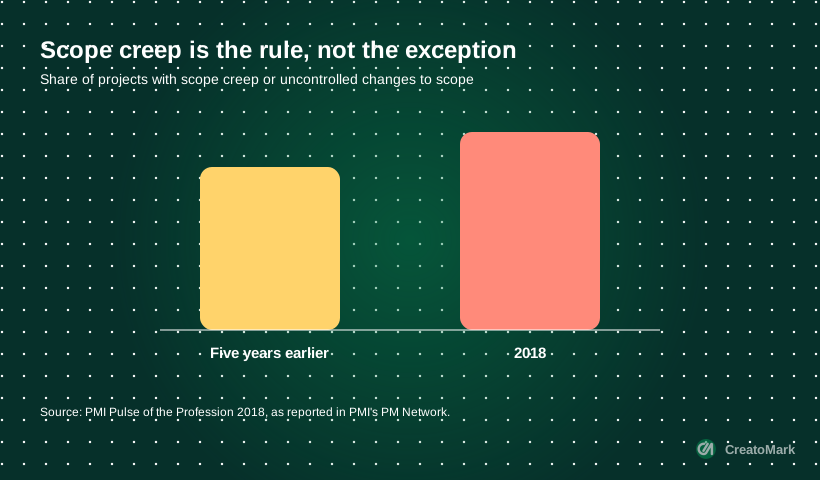
The Project Management Institute reported that 52% of projects completed in the previous year had experienced scope creep or uncontrolled changes, up from 43% five years earlier. That’s across all industries. In agencies, where clients see work in progress and naturally have new ideas, it’s often worse.
Scope creep rarely arrives as a big request. It’s “one more page”, “a quick extra banner”, “can you just check the SEO too”. Each one takes an hour. Ten of them take a week, and none of them are on an invoice.

Every proposal lists what is included and what is not. “Out of scope” is clearer than any amount of “in scope”.
Each new ask goes on the board, even small ones. You can’t price what you never wrote down.
Anything outside scope gets a short written quote, with a price and a new date, before work starts.
For clients who always want small extras, sell a monthly block of hours. The extras become revenue.
Leak 2: time you never bill
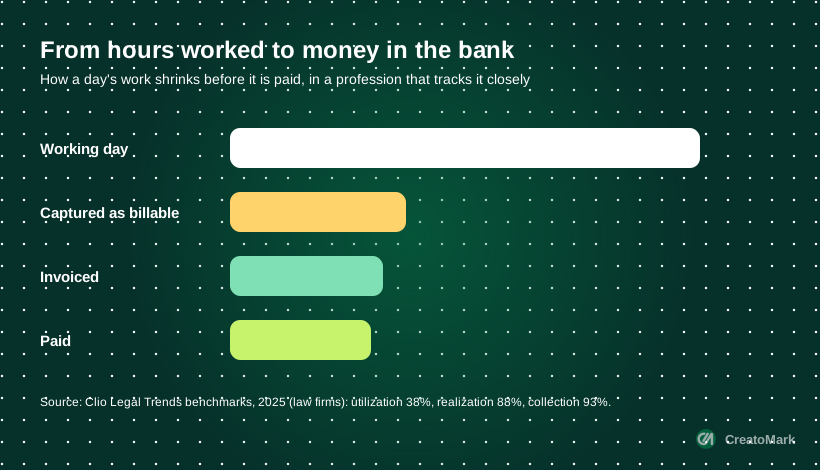
Law firms measure this more carefully than almost anyone, which makes them a useful mirror. Clio’s 2025 benchmarks show the average firm turns 38% of the working day into billable time, invoices 88% of that, and collects 93% of what it invoices. Of an eight-hour day, about 2.4 hours become money in the bank.
Agencies lose time in the same three places:
| Stage | Where agency time leaks | What to measure |
|---|---|---|
| Captured | Calls, emails, quick fixes and internal reviews nobody logs | Hours tracked against hours worked |
| Invoiced | Tracked hours written off because “it took too long” | Billed hours against tracked hours |
| Collected | Invoices disputed, discounted or never paid | Money received against money invoiced |
Even on fixed prices, track time. You don’t send the hours to the client, but they tell you whether the price was right. A fixed-price website that took twice the planned hours has a margin problem, whatever the invoice says.
Leak 3: discounts and prices that never move
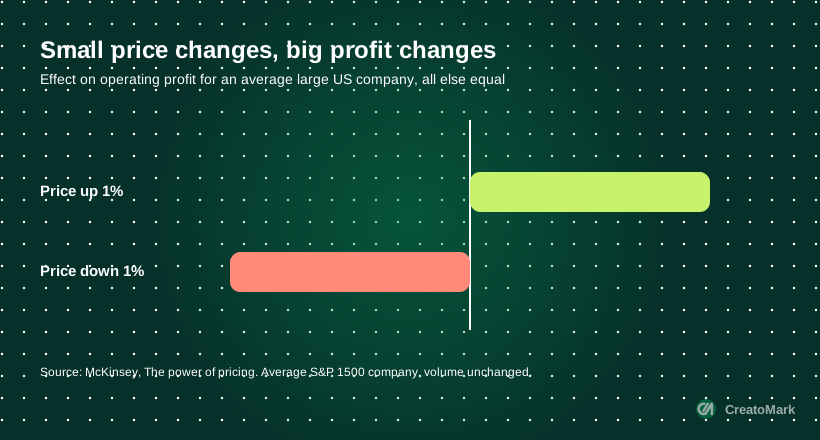
McKinsey’s classic analysis, The power of pricing, found that for an average large company, a 1% price increase with volume unchanged lifts operating profit by about 8%. A 1% price cut does the opposite. The effect was nearly 50% bigger than cutting variable costs by 1%, and more than three times bigger than selling 1% more.
Agencies are not S&P 1500 companies, but the logic is the same, and often stronger: when your margin is thin, every percent of price is a large share of your profit. That’s why the 10% discount you gave to close a deal can cost far more than 10% of the profit on it.
Where price leaks
How to plug it
If you haven’t raised prices in a while, our guide to raising prices without losing clients walks through the conversation step by step.
Leak 4: tools nobody uses
Software creeps in one subscription at a time: a design tool for one project, a second project manager because one client prefers it, an AI tool someone tried for a month. Zylo’s 2025 SaaS Management Index put average software spend at $4,830 per employee, up 21.9% in a year, and found companies with up to 500 staff use 152 apps on average.
Those figures come mostly from larger companies, so a small agency will spend less. But the pattern is familiar: tools get added for a reason and never removed when the reason ends.
01
Export every subscription
Pull 12 months of card and bank statements and list every recurring software charge.
02
Mark the owner and the use
Who uses it, for which clients, and when it was last opened.
03
Cut, merge or downgrade
Cancel what nobody uses, merge tools that do the same job, and drop unused seats.
04
Bill client-specific tools
Software bought for one client’s project should be in that client’s price, not your overhead.
Leak 5: invoices that go out late
Late payment doesn’t only hurt cash flow. Every week you wait to send an invoice, or to chase one, costs you time, and sometimes the client’s goodwill. We cover the numbers and the fixes in detail in the 7 numbers to check every week. The short version:
- Invoice the day work is delivered, not at the end of the month.
- Take a deposit on every project, and bill retainers in advance.
- Automate reminders, so chasing never depends on how busy you are.
- Stop new work for clients more than 30 days overdue, politely and in writing.
Leak 6: rework
Rework is work you do twice: a design rebuilt because the brief was unclear, a site fixed after launch because nobody tested it on a phone, copy rewritten because the client’s feedback arrived in three different emails. It’s paid once and delivered twice.
The fix is boring, and it works: a proper brief before work starts, one channel for feedback, and a checklist before anything reaches the client. We describe a simple version in how to run your agency remotely.
What small leaks add up to (an illustration)
Here’s an agency billing $20,000 a month. None of these leaks would worry anyone on its own:
| Leak | Monthly cost | How it happens |
|---|---|---|
| Scope creep | $1,200 | About 20 unbilled hours of “quick extras” at $60 an hour |
| Untracked time | $900 | 15 hours of calls and fixes never logged |
| Old discounts | $600 | Two clients still on a 10% first-year discount |
| Unused tools | $300 | Seats and apps nobody opens any more |
| Rework | $600 | 10 hours redoing work after unclear feedback |
| Total | $3,600 | 18% of revenue, every month |
These are illustrative numbers, not a benchmark. Run your own figures through the audit below. Most owners are surprised by at least one line.
Run a one-hour margin audit
Your margin audit checklist
Fix the biggest leak first. Then make the fix a habit, such as a weekly scope log or a yearly price review, so the leak stays closed.
Make delivery costs predictable
Several of these leaks share one cause: delivery costs you can’t predict. When a project overruns, your own team’s hours pay for it. A white-label partner with fixed prices turns that uncertainty into a known cost you can quote against, which makes your margin per project much easier to protect. We compare the options in white-label vs hiring.
At CreatoMark, our own team delivers WordPress development, website care plans and more under your brand, with the scope agreed up front. Recurring services like care plans also help you turn one-off projects into monthly revenue.
Want to see where your margin goes? Book a growth call and we’ll look at which work could move to a fixed price, or compare plans on our pricing table.
The bottom line
Agencies rarely lose money on the work they price. They lose it on the work they don’t: the extras, the untracked hours, the old discounts and the things done twice.
You don’t need to work harder to earn more. Find the leaks, close the biggest one this month, and the same amount of work will leave more in the bank.