


Let’s talk about the January problem.
You finish the year strong. A handful of big website launches, happy clients, a healthy bank balance. Then January arrives, the pipeline is thin, and you’re back to chasing the next project to cover payroll.
If that sounds familiar, you’re far from alone. Project work is how most agencies start, and plenty still rely on it. But it’s also why so many agency owners never quite feel safe, no matter how good the last quarter was.
The fix isn’t to stop doing projects. It’s to make every project the start of a relationship, not the end of one.
Why project-only income keeps you up at night
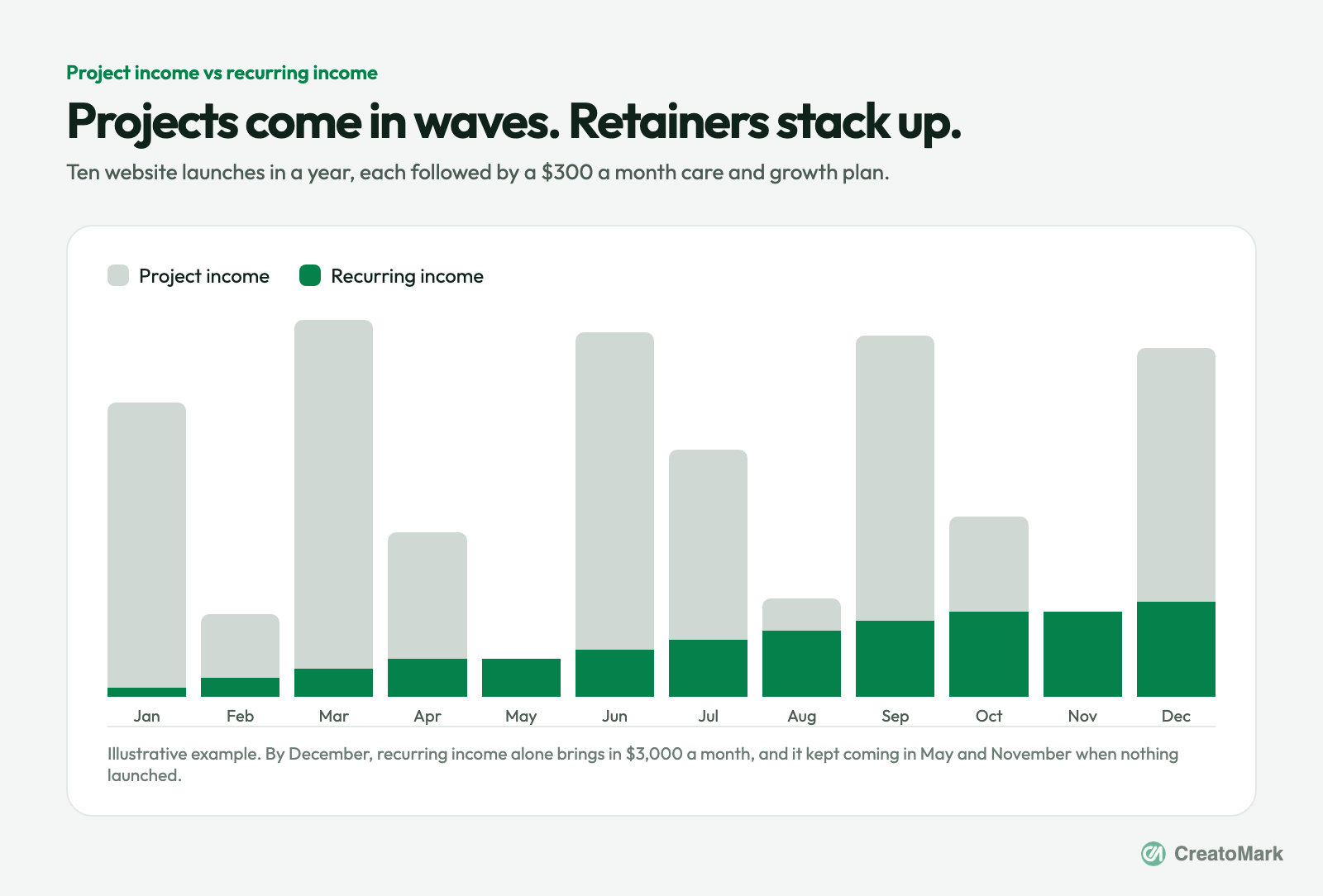
Project income has three problems:
- It’s lumpy. Big months, empty months, and very little control over which is which.
- It resets to zero. Every new month starts with the same question: where’s the next project coming from?
- It undervalues your best clients. You do your finest work at launch, then hand over the keys and walk away from all the value that comes after.
Recurring revenue fixes all three. Even a modest monthly base changes how you run the agency. You can hire with confidence, say no to poor-fit projects and plan more than a few weeks ahead.
The revenue ladder: four steps after launch
Think of every client as a ladder. The website launch is the first step. Each step after that is a monthly service that keeps the site working harder for them, and keeps revenue coming in for you.
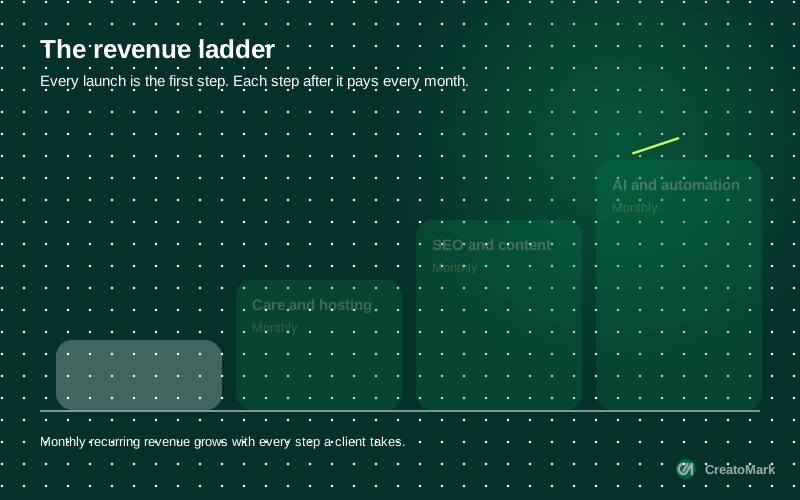
Step 1: The launch
This is the project you already sell: the new website, the redesign, the online store. Do it brilliantly, because everything else depends on the trust you build here.
Step 2: Care and hosting
Every website needs updates, backups, security checks and the occasional small edit. Most clients don’t want to think about any of it, which makes a care plan the easiest first step on the ladder. Add managed hosting and you’ve taken another headache off their plate.
Prices vary a lot here. One study of UK agency price lists found a median entry-level care plan of about £50 a month, while plans with included edit time and faster support cost much more. Price on what’s included and how fast you respond, not on updates alone.
If you’d rather not run this in-house, our white-label website care plans and hosting and migration services run quietly behind your brand.
Step 3: Growth with SEO, content and ads
A website nobody visits is a brochure in a drawer. Once the site is live and cared for, the natural next question from any client is: how do we get more leads from it?
That’s your opening for monthly SEO, content and paid media. Results from these services build over time, which makes them natural retainers. The longer a client stays, the better their numbers look.
Step 4: AI and automation
This is the newest step, and the one clients are asking about more and more. A chatbot that answers common questions on their website. An automation that sends new leads straight into their CRM. Small tools, big time savings.
Because they need tuning and support after launch, they fit neatly into a monthly plan. See what’s possible on our AI services page.
How to package it so clients say yes
Clients don’t buy services. They buy outcomes and peace of mind. So package your ladder into a few clear tiers instead of a long menu.
| Package | What’s included | Best for |
|---|---|---|
| Essential care | Updates, backups, security checks, uptime monitoring and one hour of small edits | Every client, from launch day |
| Growth | Everything in Essential, plus monthly SEO, two blog posts and a short report | Clients who want more leads |
| Growth plus AI | Everything in Growth, plus a website chatbot and one automation, tuned monthly | Busy clients buried in admin |
These are example packages. Set your own prices based on your market and what each tier costs you to deliver.
A few rules that help packages sell:
- Three options, not ten. Too much choice stalls the decision.
- Name the outcome, like “Growth”, not the task list.
- Explain what happens without it. An outdated plugin can take a site down. Say so, kindly.
- Make the middle tier the obvious pick. Most clients choose it anyway.
When to pitch it: the handover moment
The best time to sell a retainer is before the project ends, not after. At handover, your client is happy, excited and paying full attention. Use that moment.
- Put it in the proposal. Include your care plan as a recommended line item from day one, so it never feels like an upsell.
- Show the plan at launch. Walk your client through what you’ll check, update and report on each month.
- Book the first check-in. Put a 30-day review in the diary before you hand over the keys.
When care is part of the original proposal, most clients simply say yes. It’s the agencies that bring it up three months later who hear “we’re fine, thanks”.
Delivering it without hiring for every step
Here’s the catch. Each step on the ladder needs different skills: WordPress maintenance, server management, SEO, writing, ad management, AI. Hiring a specialist for each one before the retainers are signed is how agencies get into trouble.
This is where a white-label partner earns its keep. You sell the packages under your brand. Your partner delivers them, and you keep the margin. And because monthly hours flex across skills, one plan can cover care work for twenty clients and SEO for five of them.
If you’re weighing up partners, our guide to choosing a white-label partner covers the questions to ask. And if you’re comparing the cost against a new hire, start with white-label vs hiring.
Ready to build your own ladder? See how our plans work on the pricing table, or book a growth call and we’ll help you map out packages for your clients.
Start with one step
You don’t need to launch four new services next week. Start with care plans, the easiest yes. Add them to every new proposal, and offer them to your last ten clients.
Once that base feels steady, add growth services for the clients who want more. Then AI for the ones who are ready. One step at a time, project income becomes monthly income, and January stops being scary.