


Every new client starts the same way: a call, a custom proposal, a few rounds of back and forth on scope, a price you’re not quite sure about, and a timeline you hope you can hit. Then the project ends, and you start again from zero.
That’s the project treadmill, and most small agencies live on it. A productized service is the way off: the same well-defined service, sold at the same price, delivered the same way, to every client who needs it. Done well, it turns scattered one-off work into revenue you can plan around.
In this article
What makes a service a product
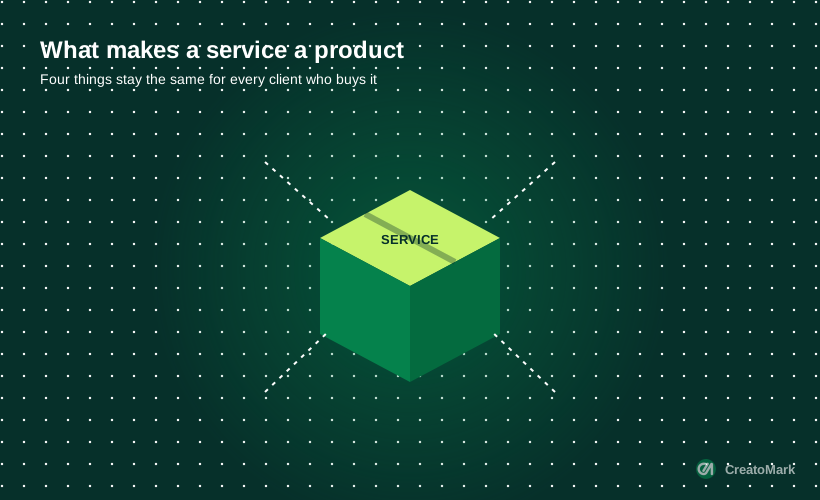
A productized service isn’t a template or a cheap package. It’s a service where the important decisions are made once, by you, instead of on every sales call. The client still gets work done for their business, but they buy it the way they’d buy a product: they know what they get, what it costs and when it arrives.
Custom project
Productized service
Why recurring clients are worth so much more
9x to 12x
EBITDA is a reasonable sale multiple for mid-sized agencies with strong recurring revenue
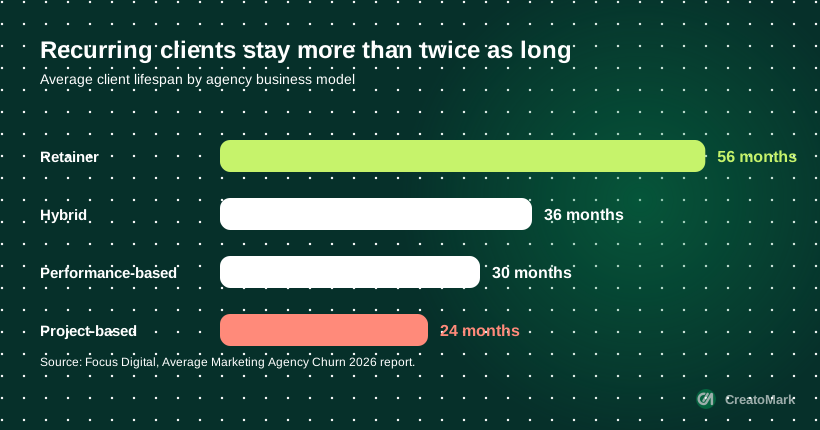
According to Focus Digital’s research on agency churn, clients on retainers stay an average of 56 months, against 24 months for project-based work. That’s more than twice the revenue from every client you win, without paying to win them again.
It matters when you sell the business, too. Buyers pay more for predictable income: FE International suggests 9x to 12x EBITDA is reasonable for a mid-sized agency with strong recurring revenue, a level project-led agencies rarely reach. And subscription models are growing well beyond agencies. Zuora, which sells subscription billing software, reports that the companies in its Subscription Economy Index grew revenue faster than the S&P 500. A vendor source, but the direction is clear.
It’s also how agencies raise prices. In Convert’s agency research report, 72% of agencies that raised prices did it by moving into higher-value work, not by charging more for the same thing. A well-packaged service is higher-value work. We cover the full approach in How to Raise Your Agency’s Prices.
Build your first productized service in five steps
01
Find the job you keep repeating
Look at your last 20 projects. Which request comes up again and again? Site updates, landing pages, speed fixes, monthly SEO? That’s your first product.
02
Fix the scope
Write down exactly what’s included and, just as important, what isn’t. Anything outside the list becomes a paid add-on, not a favour.
03
Set one price
Work out the real hours and costs from past jobs, add your margin, and publish one price. No custom quotes for the core offer.
04
Document the process
Turn delivery into checklists and templates, so quality doesn’t depend on one person remembering how it’s done.
05
Make it recurring
Wherever you can, sell it monthly or quarterly. A one-off launch can lead straight into a monthly plan.

A simple productized menu
You don’t need a long list. Three offers are enough for most small agencies: a low-risk entry offer that gets a new client started, a monthly core that becomes your recurring revenue, and an upsell for clients who want more growth.
| Offer | Example | Role in your business |
|---|---|---|
| Entry offer | Website audit, launch review, speed fix | Low risk for the client. Builds trust quickly. |
| Monthly core | Care plan, SEO plan, content plan | Predictable revenue. Keeps you close to the client. |
| Upsell | Landing page sprint, conversion tests, new features | Extra revenue from clients who already trust you. |
Example structure. Set prices from your own delivery costs and market.
The monthly core is where the money is. For website clients, a care plan is usually the easiest place to start, and we walk through the full path from projects to retainers in From One-Off Projects to Monthly Revenue.
Mistakes to avoid
Package work you’ve already delivered many times. If you’re still working out how to do it, it isn’t ready to be a product.
“Unlimited small edits” sounds generous until one client sends 40 requests. Name the limits clearly.
Price on the result for the client and your real costs, including management, tools and revisions.
Ten packages bring back the custom-quote problem. Start with three and add more only when clients ask.
Make the decisions once, write them down, and sell the same thing well again and again.
Deliver it without growing your payroll
A productized service only works if you can deliver it the same way every time, even when five new clients sign up in one week. That’s where a white-label partner helps: we handle the delivery under your brand, from website care plans to WordPress development, so you can focus on selling and client relationships.
Ready to package your services? Book a growth call and we’ll help you shape your first productized offer, or compare plans on our pricing table.
Before you launch a productized service
The bottom line
Custom work will always have a place, but it shouldn’t be the whole business. Package the work you already do well, give it a fixed scope and price, and sell it on a monthly basis wherever you can.
Fewer proposals, faster sales, clients who stay longer and revenue you can actually plan around. That’s what productizing gives a small agency.