


Every agency owner we talk to is asking some version of the same question: “Should we be using AI more, and how do we do it without our work getting worse?”
It’s a fair worry. You’ve probably seen the headlines promising AI will do the work of a whole team. You’ve probably also seen a junior paste something an AI tool wrote straight into a client deliverable, and spent the afternoon fixing it.
The truth sits in the middle. Used well, AI takes real hours out of every project. Used carelessly, it moves the work from doing to fixing. Let’s look at what the research says, where AI genuinely helps an agency, and the one rule that keeps your quality where your clients expect it. If you also want to sell AI to clients, see How to Sell AI Chatbots and Automations.
The short version: let AI draft, and let people decide. Use it to get from a blank page to a solid first version faster, then put your best people on review. The faster the draft, the more the review matters.
What the research actually says
Almost everyone is using AI now. In the 2025 Stack Overflow Developer Survey, 84% of developers said they use or plan to use AI tools in their work. So the question isn’t whether your team uses it. It’s whether they use it well.
And here’s where it gets interesting. In a controlled study by GitHub, developers using an AI assistant finished a simple, well-defined coding task 55% faster than those without one. That’s the number you’ll see quoted everywhere.
But a 2025 randomised trial by METR tested experienced developers on real tasks in large projects they already knew well. With AI tools, they took 19% longer. The strangest part? They believed AI had made them about 20% faster.
At team level, Google’s 2024 DORA report found that more AI use was linked to small gains in documentation and code quality, but also to an estimated 7.2% drop in delivery stability. More code, produced faster, can mean more things breaking on the way out.
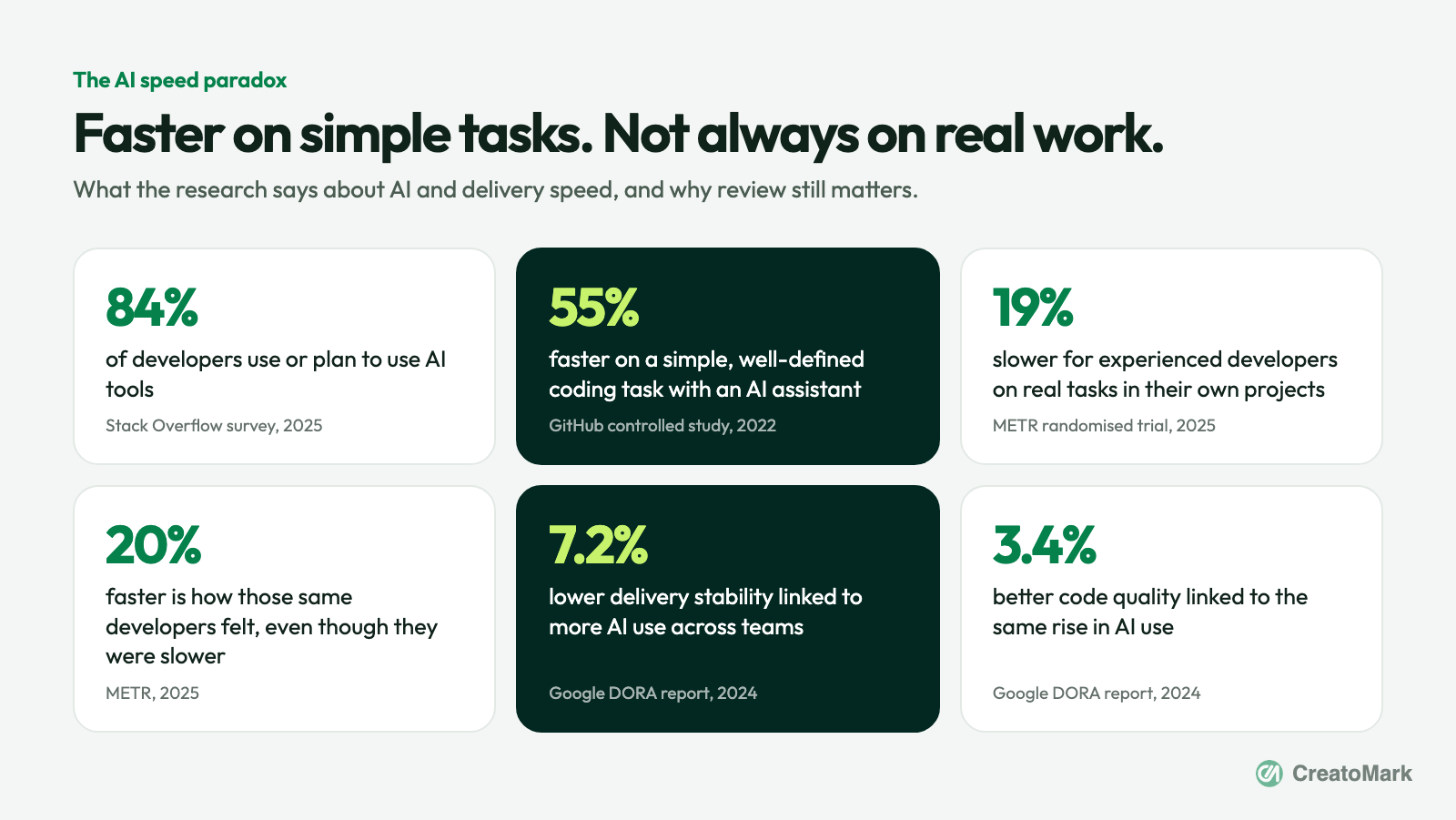
Put those together and a clear pattern appears. AI is brilliant at well-defined, repetitive work. It’s much less reliable on messy, real-world work that needs context and judgement. That’s exactly how an agency should divide it up.
Where AI genuinely helps an agency
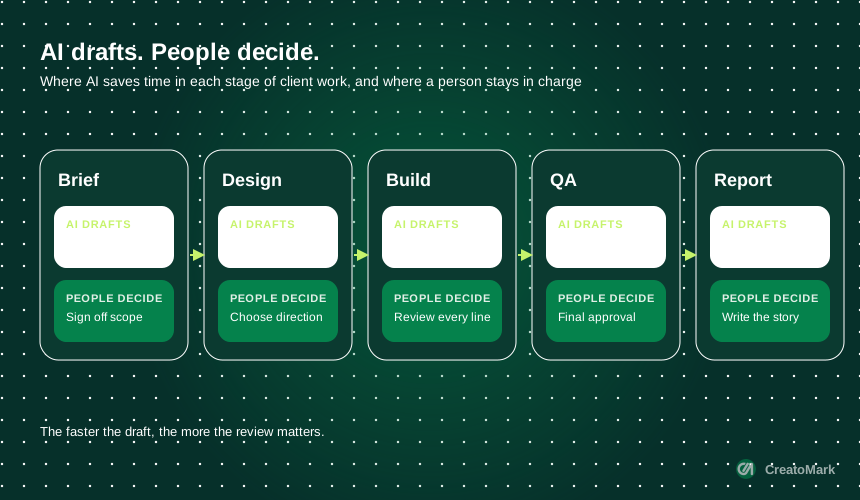
Think of each stage of a client project as two parts: the draft and the decision. AI is great at the first. Your team owns the second.
Briefs and discovery
Turn a messy call recording into a clean summary, a list of open questions and a draft scope. You still sign off the scope with the client, but you start from a page instead of a blank document.
Design and content
Use AI for moodboard directions, first-draft headlines, image alt text and page outlines. Then a designer and a writer choose, shape and polish. Clients can tell when nobody did that last step.
Development
Boilerplate, repetitive components, small scripts, test cases and explanations of unfamiliar code are where AI shines. Architecture, security and anything touching customer data stay firmly with a senior developer. Our own developers work this way on WordPress builds and AI-assisted builds: AI speeds up the routine parts, and a senior reviews every line before it ships.
QA
Ask AI to generate test checklists, find broken links and spot missing alt text or meta descriptions. A person still clicks through the site on a real phone before anything goes to the client.
Reporting
Pulling numbers from analytics and ad platforms into a first draft saves hours every month. The story, what changed, why and what’s next, is still yours to write. That’s what clients pay for.
Where AI quietly costs you time
- “Almost right” output. In the same Stack Overflow survey, 66% of developers said their biggest frustration is AI answers that are almost right, but not quite. Almost right is often slower to fix than writing it fresh.
- Bigger changes, harder reviews. AI makes it easy to produce a lot at once. Large changes are harder to review properly, which is one likely reason the DORA data showed stability slipping.
- Confident mistakes in client-facing copy. Wrong facts, made-up statistics and off-brand tone are easy to miss when you’re moving fast.
- Feeling faster than you are. The METR result is a warning: measure real turnaround times, not how fast it feels.
The rule that keeps quality high
AI drafts. People decide. Nothing reaches a client without a person who understands it signing it off.
In practice, that looks like:
- Write down where AI is allowed. A one-page policy: which tasks, which tools, and what never goes into them (client passwords, private data).
- Keep changes small. Ask for one component or one section at a time, so every piece gets a real review.
- Make review someone’s job. A named senior reviewer for code, design and copy, every time.
- Measure turnaround and rework. Track how long tasks really take and how often they come back. Keep what saves time, drop what doesn’t.
Turn the time you save into growth
Here’s the business case. If AI saves your team a few hours on every project, you have three choices: deliver faster, take on more work, or spend the time on things clients value more, like strategy and better communication. The agencies that grow choose the last two.
And you don’t need to build all of this in-house. A white-label partner whose team already works with AI day to day can take on the production work, while your people focus on clients and strategy. That’s also how many agencies are starting to sell AI services of their own, like chatbots and automations.
Want to see how a team uses AI without cutting corners? Book a growth call and we’ll walk you through our process, or compare plans on our pricing table.
The bottom line
AI won’t replace a good agency. But an agency that uses it well will outpace one that doesn’t. Use it for the draft, keep people on the decisions, and measure what really changes. That’s how you get faster without your clients ever noticing a drop in quality, only an improvement in speed.