


“We should probably be doing something with AI.”
If you work with small businesses, you’ve heard this. Maybe in a review meeting, maybe as a throwaway line at the end of a call. The client doesn’t know exactly what they want. They just know their competitors are talking about it, and they don’t want to be left behind.
That’s a huge opportunity for agencies. It’s also a trap. Sell the dream (“it’ll handle all your customers!”) and you’ll spend the next three months apologising. Sell something small, useful and honest, and you’ve got a client who trusts you with the next project.
Let’s look at what small businesses actually pay for, what to promise, how to price it and how to deliver it without hiring an AI team.
The short version: start with one clear job, like capturing leads after hours. Always give customers a way to reach a human. Charge a setup fee plus a monthly fee, because good chatbots get tuned, not just installed.
Why now: the demand is real
- Small businesses are already using AI. The US Chamber of Commerce’s 2025 report found 58% of small businesses use generative AI, up from 40% in 2024 and more than double the 2023 rate.
- Bigger companies are moving too. Gartner found that 85% of customer service leaders planned to explore or pilot customer-facing conversational AI in 2025.
But here’s the number most AI salespeople leave out. In a Gartner survey of 5,728 customers, 64% said they’d prefer companies didn’t use AI for customer service. Their top worry? That it would get harder to reach a real person.
Customers don’t hate AI. They hate being trapped by it. Build the escape hatch in from day one.
That single insight shapes everything below. The chatbots that work are the ones that answer simple questions fast and hand everything else to a human, gracefully.
Five use cases small businesses actually pay for
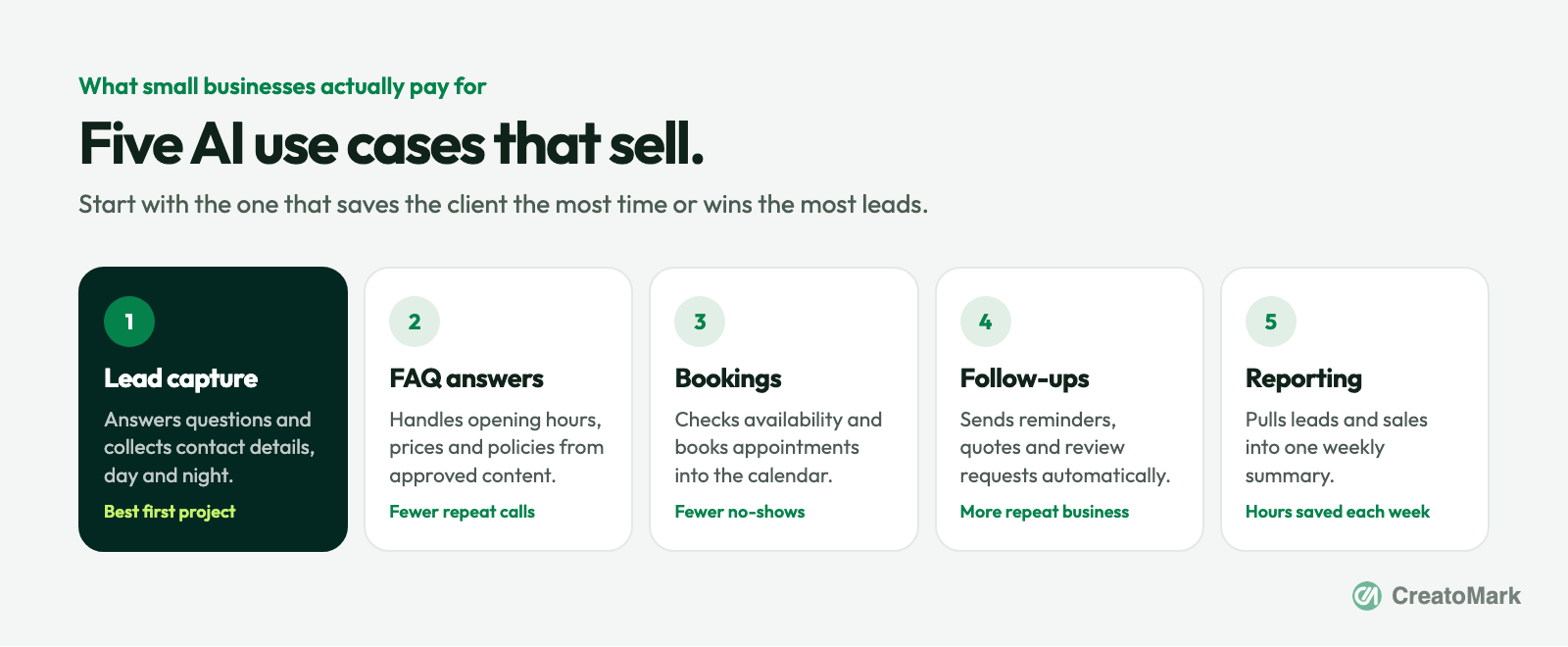
1. Lead capture after hours
This is the best first project, by a distance. A plumber, a dentist or a law firm gets enquiries at 11pm. A chatbot can answer the basic question, collect a name and number, and send it straight to the team.
Speed matters here. A widely cited Harvard Business Review analysis of over a million sales leads found companies that contacted a lead within an hour were nearly seven times as likely to qualify it as those that waited even one hour longer. A chatbot that responds instantly, then alerts a human, puts that to work.
2. FAQ answers
Opening hours, prices, delivery areas, return policies. The questions staff answer twenty times a day. A chatbot trained only on the client’s approved content handles these well and frees up the phone.
3. Bookings
Checking availability and booking straight into the calendar, with reminders. Fewer back-and-forth emails, fewer no-shows.
4. Follow-ups
This is automation rather than a chatbot: sending a quote reminder, a “how did we do?” review request or a re-booking nudge at the right moment. Quiet, reliable, and clients love it.
5. Reporting
Pulling leads, bookings and sales from a few different tools into one simple weekly summary. Not glamorous, but it can save a business owner hours every week.
What to promise (and what never to promise)
Here’s a cautionary tale every agency should know. In 2024, a tribunal in British Columbia ruled that Air Canada was liable for wrong information its website chatbot gave a customer about bereavement fares. The airline argued the chatbot was responsible for its own actions. The tribunal disagreed: the chatbot was part of the website, so the business was responsible for what it said.
In other words: your client owns every answer their chatbot gives. Set expectations accordingly.
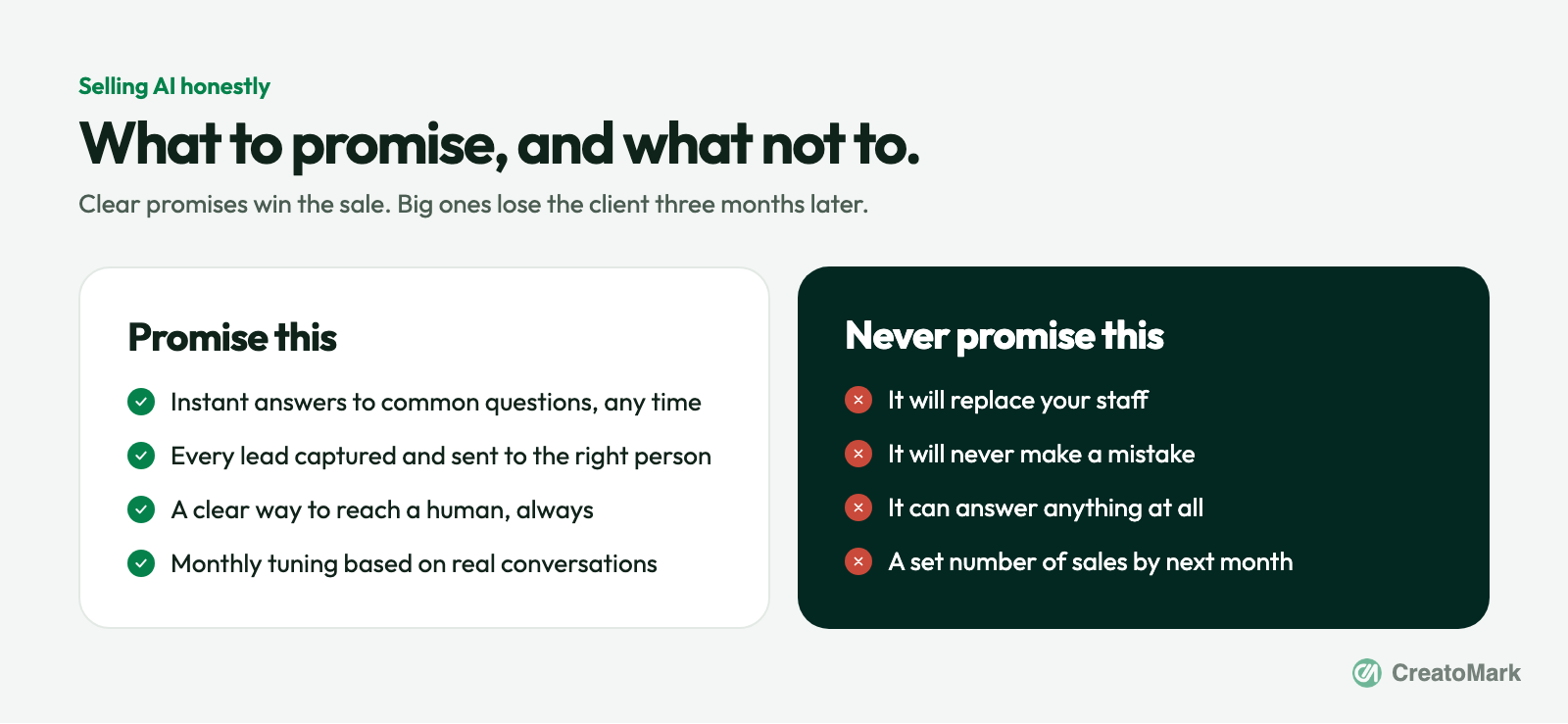
In practice, that means three rules for every build:
- Answer only from approved content. Train the chatbot on the client’s own pages, policies and FAQs, not the open internet.
- Always offer a human. A clear “talk to the team” option in every conversation, and an automatic hand-off when the bot isn’t sure.
- Review conversations monthly. Read real chats, fix wrong answers and add missing ones. This is where most of the value comes from over time.
How to price it
The simplest model that works: a one-off setup fee, then a monthly fee. The setup covers planning, building, connecting tools and testing. The monthly fee covers hosting, tuning, reviewing conversations and small changes.
| Package | What’s included | Good for |
|---|---|---|
| Starter assistant | FAQ chatbot on approved content, lead capture, email alerts, monthly review | Most small businesses |
| Booking assistant | Everything in Starter, plus calendar booking and reminders | Clinics, salons, trades, consultants |
| Automation bundle | Chatbot plus follow-ups, review requests and a weekly report | Busy owners buried in admin |
Example packages. Set your own prices based on your market, the tools involved and what each package costs you to deliver.
Two pricing tips. First, never skip the monthly fee. A chatbot that isn’t reviewed slowly gets worse as the business changes. Second, report on outcomes the client cares about: leads captured, questions answered and time saved, not “messages processed”.
How to sell it in one conversation
- Ask one question: “What questions do you or your team answer over and over?” or “What happens to enquiries that come in after you close?”
- Pick one use case from their answer. Don’t sell a platform. Sell a fix for that one problem.
- Show a demo of a simple conversation in their industry, including the hand-off to a human.
- Start small with a 30-day pilot, then review the conversations together and decide what’s next.
This is consultative selling, and it works because it’s honest. If a client needs help working out where AI fits across the whole business, a fractional AI consultant can run that discovery with them, under your brand.
Delivering it without hiring an AI team
You don’t need in-house AI engineers to offer this. You need someone reliable to build, connect, test and tune it, and you need it to arrive under your name. That’s exactly what a white-label partner is for.
Our team builds AI chatbots and workflow automations for agencies, delivered white-label, with monthly reviews included. You can see the full process on how AI projects work, and if you’re new to white-label, start with how to choose a white-label partner.
Have a client asking for “something with AI”? Book a growth call and we’ll help you pick the right first project, or see our plans on the pricing table.
The bottom line
AI is easy to oversell and surprisingly easy to sell well. Pick one real problem, solve it simply, keep a human in the loop and tune it every month.
Do that, and “we should probably be doing something with AI” stops being a vague worry for your client. It becomes a monthly service they’re glad to pay for, and the next step in a long relationship with your agency.
Sources
- U.S. Chamber of Commerce: Empowering Small Business report (August 2025)
- Gartner: 64% of customers would prefer that companies didn’t use AI for customer service (July 2024)
- Gartner: 85% of customer service leaders will explore or pilot customer-facing conversational GenAI in 2025
- American Bar Association: BC tribunal confirms companies remain liable for information provided by AI chatbot
- Harvard Business Review: The Short Life of Online Sales Leads (2011)