


It usually arrives as a short email. Sometimes it’s a voice note. Either way, the question is the same:
“Is ChatGPT going to kill our Google traffic? Do we still need SEO?”
If you run an agency, you’ve probably had a version of this from at least one client this year. And you’ve probably felt the pressure to give a confident answer, even though the ground is still moving.
So let’s slow down and look at what’s actually happening. Real numbers, from real sources. Then we’ll cover what still works, what’s genuinely different, a checklist you can run on any client site, and the words you can use to explain all of it without scaring anyone.
The short answer for your client: search isn’t disappearing, but it’s changing shape. Fewer people click when an AI answer appears, so the goal is shifting from ranking to being the source the answer is built on. Good SEO is still the foundation. It just needs a few new habits on top.
What’s actually happening (the numbers)
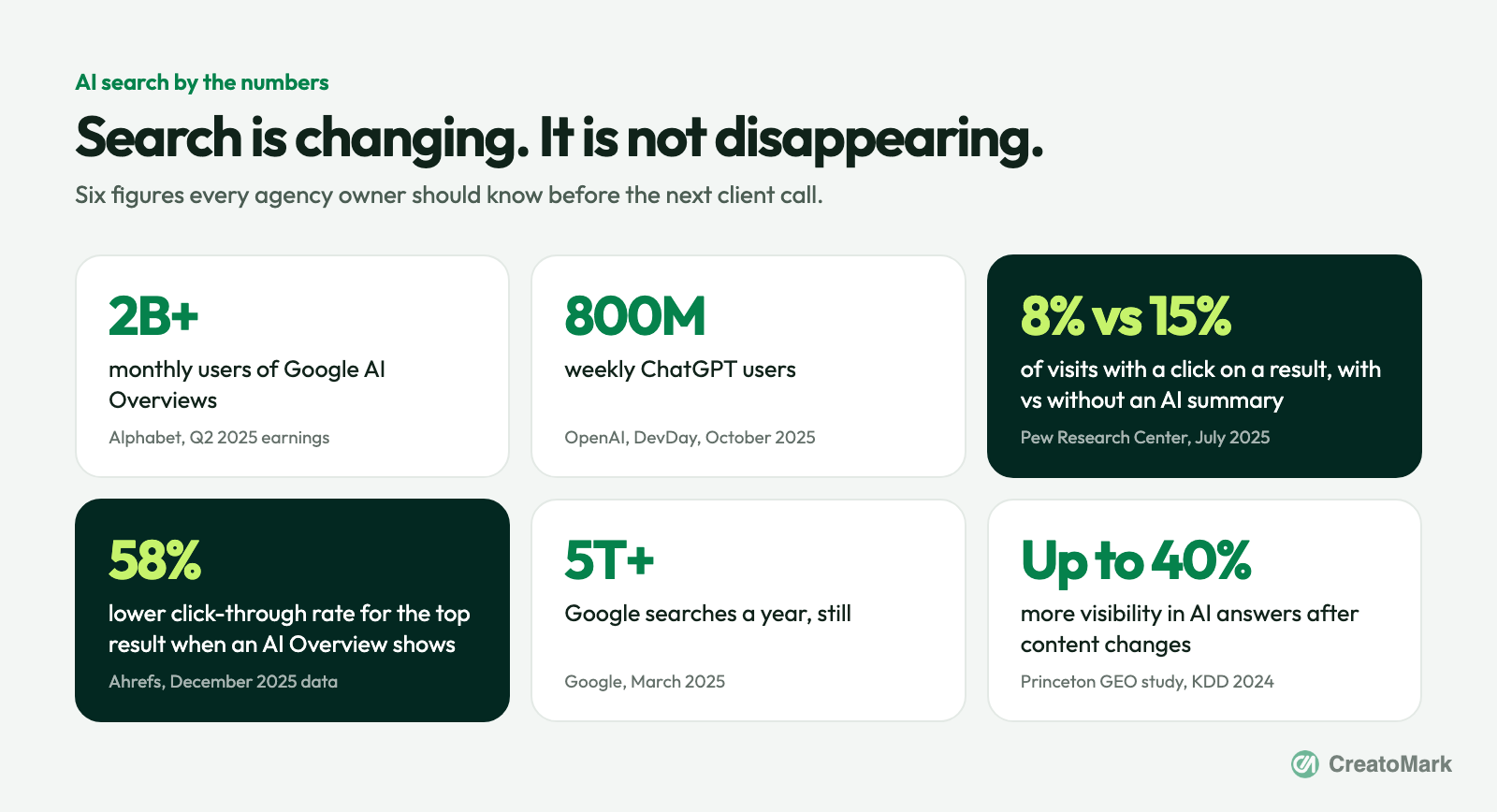
First, the scale. Search is not shrinking into nothing. Google says it handles more than 5 trillion searches a year. At the same time, AI answers have gone mainstream fast:
- Google’s AI Overviews reached more than 2 billion monthly users, according to Alphabet’s Q2 2025 earnings.
- ChatGPT hit 800 million weekly users in October 2025.
So people are using both. The real question is what happens to clicks when an AI answer sits on top of the results.
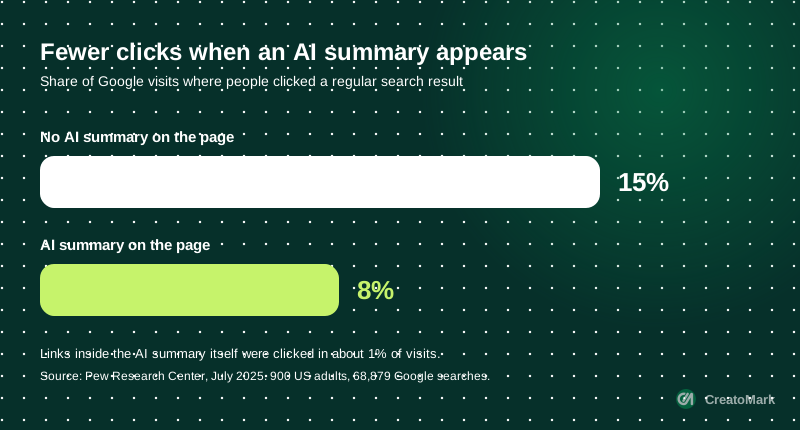
Fewer people click when an AI summary appears
In July 2025, Pew Research Center looked at the real browsing activity of 900 US adults across 68,879 Google searches. When an AI summary appeared, people clicked a regular result in 8% of visits. Without one, they clicked in 15%. Links inside the summary itself were clicked in just 1% of visits, and people were more likely to end their browsing session right there.
Ahrefs found something similar from a different angle. Looking at 300,000 keywords with December 2025 data, the top-ranking page earned a 58% lower click-through rate on average when an AI Overview appeared. Their earlier study, with spring 2025 data, put the drop at 34.5%. Worth noting: both are correlations, not proof of cause, but the direction is clear.
And back in 2024, Gartner predicted that traditional search engine volume would drop 25% by 2026 as people turn to AI assistants. That’s a forecast, not a measured result, so treat it as a signal of where things are heading rather than a fact.
How AI answers choose their sources
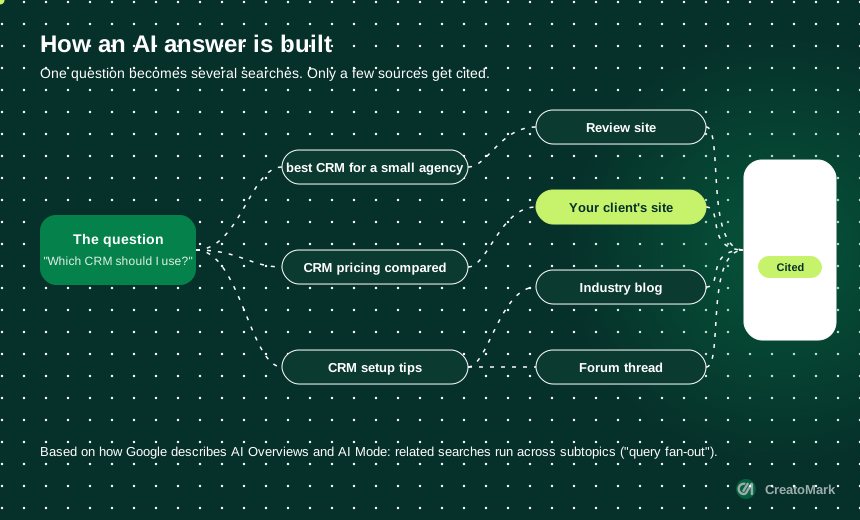
Here’s the part most clients have never had explained. An AI answer isn’t magic, and it isn’t random. It’s built from web pages.
Google explains in its guide to AI features that AI Overviews and AI Mode may run several related searches across subtopics to build one answer. Google calls this query fan-out. A single question like “which CRM should I use?” quietly becomes searches about pricing, setup, comparisons and reviews. The answer then cites a handful of the pages it found along the way.
Two details from Google’s own documentation are worth repeating to every client:
- To appear as a source, a page must be indexed and eligible to show in Google Search with a snippet. Google says there are “no additional technical requirements” beyond that.
- There’s no secret extra step. In Google’s words, there are “no additional requirements to appear in AI Overviews or AI Mode, nor other special optimizations necessary.”
ChatGPT search works on its own crawler. OpenAI’s documentation explains that sites that block OAI-SearchBot “will not be shown in ChatGPT search answers.” That’s a different crawler from GPTBot, which OpenAI uses for training. Many sites block both without realising they’ve just made themselves invisible in ChatGPT search.
What still works from classic SEO
This is the reassuring part, and it’s true. Google states plainly that the best practices for SEO remain relevant for its AI features. So everything your agency already does well still matters:
- Technical health. Fast, crawlable, indexable pages with clean internal links. If a page can’t be found, it can’t be cited. Our technical SEO work starts here for exactly that reason.
- Helpful, people-first content. Pages that genuinely answer what a customer is trying to figure out.
- Authority and trust. Real expertise, real reviews, a real business behind the site.
- Local signals. For local businesses, a complete Google Business Profile and consistent details across the web still carry weight. See our local SEO approach.
What changes with GEO
GEO, or generative engine optimisation, is the name for making content easier for AI systems to find, understand and cite. It builds on SEO. It doesn’t replace it.
The term comes from a research paper by a team including Princeton researchers, presented at KDD 2024. They tested changes to web content and found that some, like adding statistics, citing sources and including quotations, could raise a page’s visibility in AI-generated answers by up to 40%. The results varied by topic, so don’t promise clients a number. But the pattern is useful.
Google points the same way. Its advice on succeeding in AI search and its AI optimisation guide keep coming back to unique, “non-commodity” content. A first-hand story or original data beats a generic list that repeats what a hundred other pages already say.
| Focus | Classic SEO | AI search (GEO) |
|---|---|---|
| Goal | Rank on page one and earn the click | Be one of the few sources an answer is built on |
| Content | Keyword-focused pages | Direct answers, real data, first-hand experience |
| Format | Headings and keywords | Clear sections a system can lift and quote |
| Proof | Backlinks and authority | Authority plus statistics, sources and quotes |
| Crawlers | Googlebot | Googlebot, plus OAI-SearchBot for ChatGPT search |
| Tracking | Rankings and organic clicks | Clicks plus citations, AI referrals and branded search |
A checklist to make a client’s site easier to cite
You can run this on any client site in an afternoon. Most of it is good SEO hygiene anyway, which makes it an easy yes.
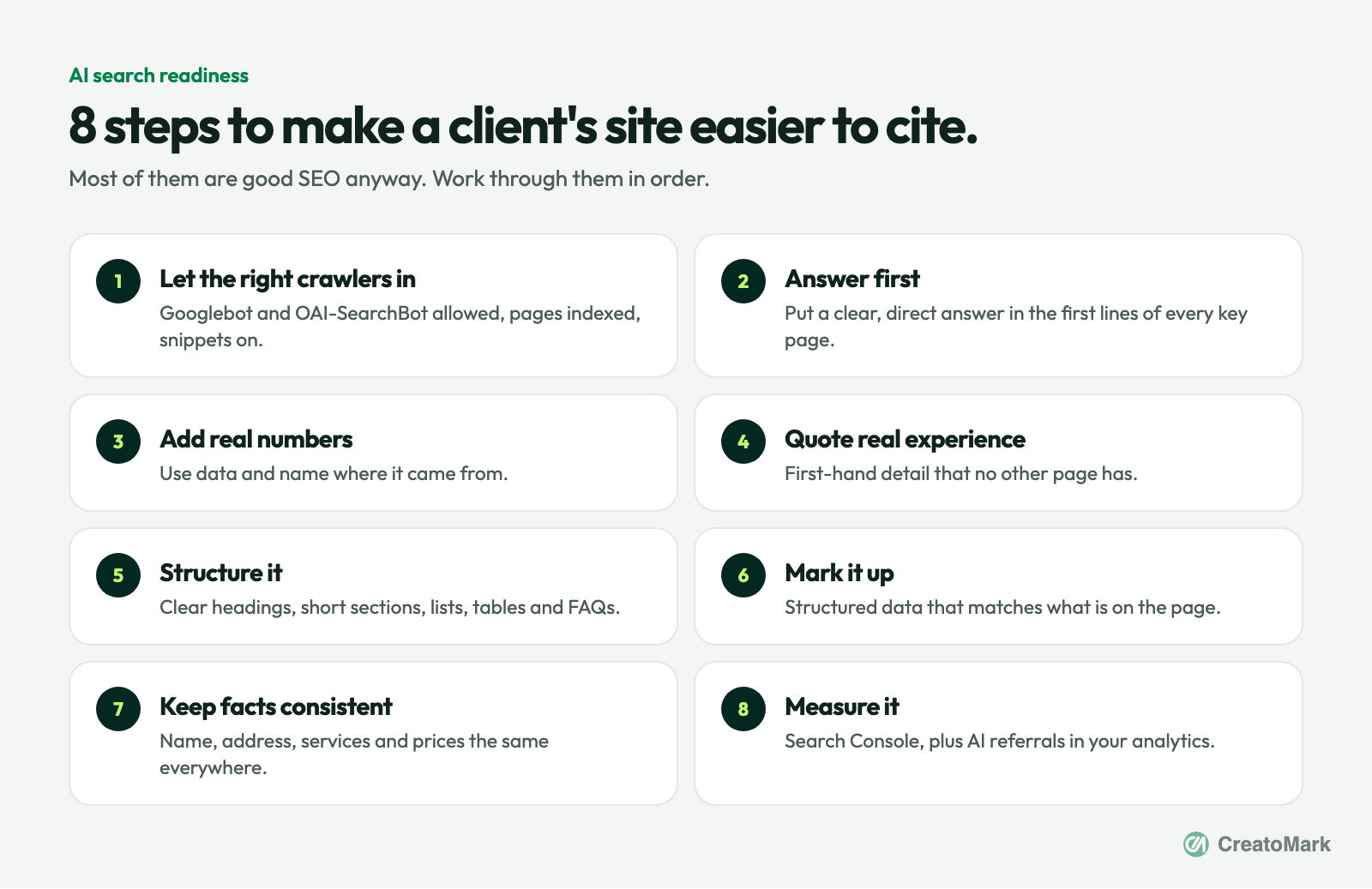
- Let the right crawlers in. Check robots.txt allows Googlebot and OAI-SearchBot, key pages are indexed, and nothing important carries a nosnippet tag. Blocking Google-Extended is fine if a client wants to: Google confirms it “does not impact a site’s inclusion in Google Search.”
- Answer first. Put a clear, direct answer in the first two or three lines of every key page, then expand. AI systems love a quotable opening.
- Add real numbers. Prices, timelines, results, survey data. And say where each number came from.
- Quote real experience. A short quote from the business owner or a customer, with a name attached, adds the first-hand detail generic pages lack.
- Structure it. Clear headings phrased like questions, short sections, lists, tables and an FAQ where it helps the reader.
- Mark it up. Add structured data that matches what’s visible on the page. Never mark up things the visitor can’t see.
- Keep facts consistent. Business name, address, services and prices should match across the site, Google Business Profile and directories. Conflicting facts make a source harder to trust.
- Measure it. Google says AI Overview and AI Mode traffic is included in Search Console’s Performance report under the “Web” search type. Add a check for referrals from ChatGPT, Perplexity and Copilot in your analytics too.
Quick win for this week: open robots.txt on your five biggest client sites. If any of them block OAI-SearchBot by accident, they’re invisible in ChatGPT search right now. It’s a two-minute fix and an easy way to show value.
What to tell your clients (you can borrow this)
Clients don’t need a lecture on query fan-out. They need to feel that someone has this under control. Here’s a short message you can adapt:
“Search is changing, not disappearing. Google still handles trillions of searches a year, but more answers now appear right on the results page. That means fewer clicks for generic content, and more value in being the source those answers quote. We’re adjusting your site so it’s easy to find, easy to understand and worth citing, while keeping everything that already works for your rankings. You’ll see this in our monthly report.”
Notice what that message doesn’t do. It doesn’t promise rankings in ChatGPT, it doesn’t claim SEO is dead, and it doesn’t invent a percentage. Calm and specific beats loud and vague, especially when clients are nervous.
Three myths worth correcting
- “SEO is dead.” Google says its SEO best practices still apply to AI features, and AI answers are built from indexed web pages. SEO is the entry ticket.
- “You need special AI files or markup to appear.” Google says there are no extra requirements or special optimisations needed for AI Overviews or AI Mode.
- “Blocking all AI bots protects the business.” It might keep content out of training, but blocking OAI-SearchBot also removes the site from ChatGPT search answers. Decide on purpose, not by accident.
How to turn this into a paid service
Every client asking “what about AI?” is a sales conversation waiting to happen. A simple way to package it:
- AI search audit (one-off). Run the checklist above, fix the crawler and indexing issues, and deliver a short report with priorities.
- Monthly SEO and GEO retainer. Content updates with real data and quotes, structured data, local consistency and ongoing technical care.
- Reporting that matches the new world. Organic clicks, branded searches, AI referrals and spot checks of whether the client is cited for their key questions.
This fits neatly into the recurring model we covered in From One-Off Projects to Monthly Revenue. And if you don’t have the hours or the specialists in-house, it’s exactly the kind of work a partner can deliver under your brand. Our AI SEO and GEO service and content writing run quietly behind your agency, with white-label reports you can forward as your own.
Want help building this offer for your clients? See how our plans work on the pricing table, or book a growth call and we’ll walk through it with you.
The bottom line
AI search is real, it’s growing, and it’s taking some clicks away from generic content. That’s the honest part of the answer.
The other honest part is that it rewards exactly what good agencies already do: technically sound sites, genuinely helpful content and real expertise. Add a few new habits (direct answers, real data, first-hand detail, the right crawlers allowed) and your clients aren’t just protected. They’re the ones being quoted.
So the next time a client asks whether ChatGPT will kill their traffic, you won’t need to guess. You’ll have the numbers, the plan and the service ready.
Sources
- Pew Research Center: Google users are less likely to click on links when an AI summary appears in the results (July 2025)
- Ahrefs: AI Overviews reduce clicks (study, updated with December 2025 data)
- Aggarwal et al.: GEO, Generative Engine Optimization (KDD 2024)
- Google Search Central: AI features and your website
- Google Search Central: Top ways to ensure your content performs well in Google’s AI experiences on Search
- Google Search Central: Optimizing your website for generative AI features on Google Search
- Google Search Central: Google’s common crawlers (Google-Extended)
- OpenAI: Overview of OpenAI crawlers
- Alphabet Q2 2025 earnings: CEO remarks
- TechCrunch: ChatGPT reaches 800 million weekly active users (October 2025)
- Search Engine Land: Google now sees more than 5 trillion searches per year
- Gartner: search engine volume prediction (February 2024)