


A client emails on Friday afternoon. They loved the last project and want a new landing page, a few site updates and, if possible, a blog refresh. By the end of the month. It’s exactly the kind of message you hoped for when you started the agency, and your first feeling is dread.
Because you already know how it goes. You say yes, you work the weekend, something else slips, and you promise yourself you’ll fix the workload “after this busy patch”. That busy patch never really ends.
This article is about a different way to grow: a delivery model that lets a small agency say yes to good work without hiring too early, turning clients away or running on empty.
In this article
The hidden cost of saying yes to everything
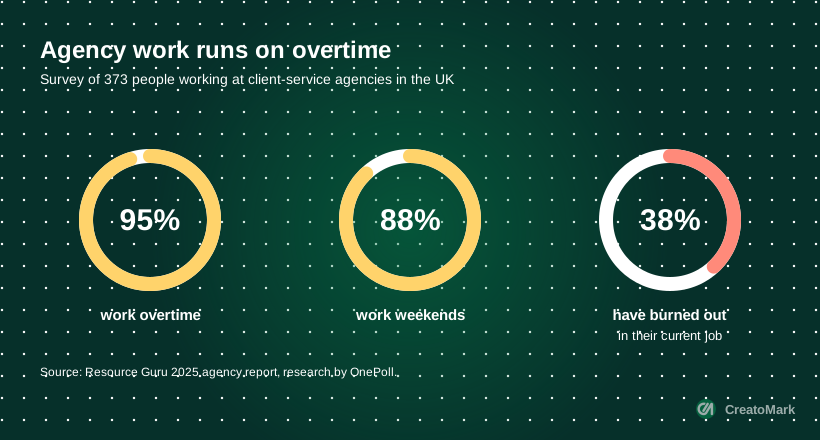
A Resource Guru survey of 373 people working at UK agencies, carried out by OnePoll in 2025, found that 95% work overtime and 88% work weekends. More than a third, 38%, have experienced burnout in their current job.
It doesn’t stay personal. Among the burned-out workers in that survey, 37% had made mistakes at work and 32% had delivered lower-quality work. The clients you said yes to end up getting a worse version of your agency.
What burnout actually is. The World Health Organization describes burnout as a result of “chronic workplace stress that has not been successfully managed”, marked by exhaustion, mental distance from work and lower effectiveness. It isn’t a personal weakness. It’s what happens when the workload has no limit.
Why the smallest agencies feel it most
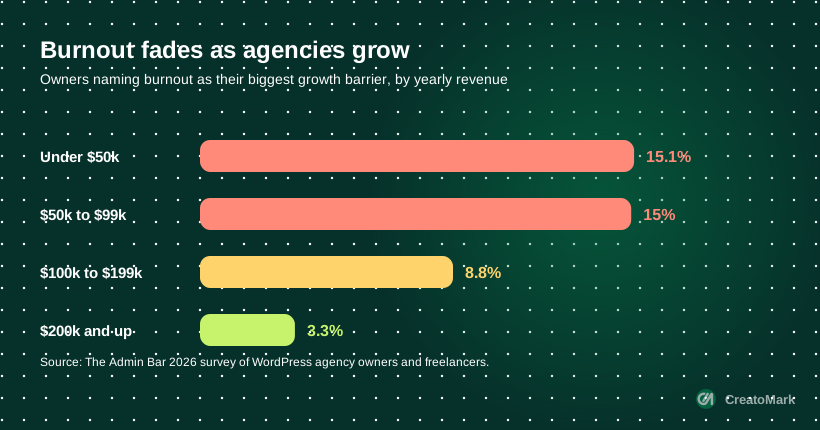
In The Admin Bar’s 2026 survey of 622 WordPress agency owners and freelancers, the median business was a team of one. And the smaller the business, the more often burnout was named as its biggest barrier to growth: 15.1% of owners earning under $50k a year, against just 3.3% of those earning $200k or more.
That makes sense. When you are the designer, developer, project manager and salesperson, every new client lands on the same person. Growth and exhaustion become the same thing.
You protect your time, but you lose revenue and send a good client to someone else, who may keep them.
You keep the client, but you pay with evenings, weekends and quality. This is the road to burnout.
You add a full salary for a few busy months. When work slows down, the cost stays and the stress moves to cash flow.
Most small agencies bounce between those three options. There’s a fourth.
The core plus flex delivery model
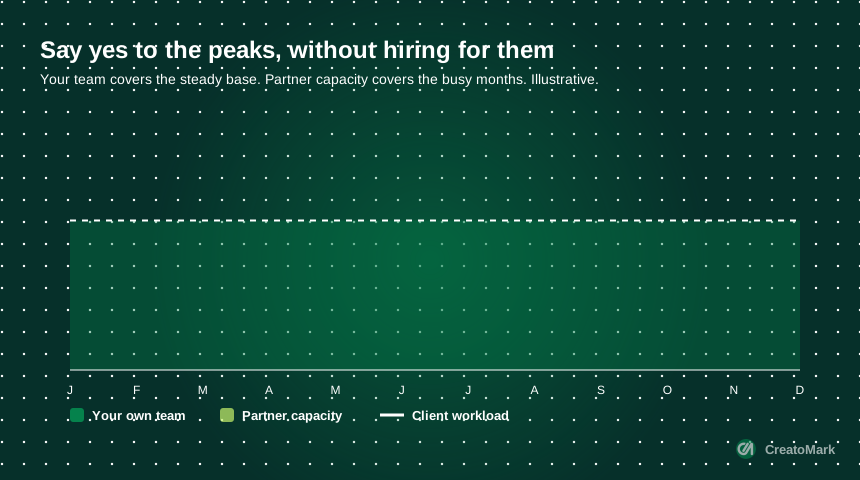
Agency workload is never flat. It rises with launches, seasonal campaigns and new clients, and it falls in between. The core plus flex model plans for that:
Your core
Your flex
Your fixed costs match your steady workload, and the peaks are covered by capacity you only pay for when you use it. You can say yes on Friday afternoon, because you know who will do the work.
How the options compare
| Model | When it’s busy | When it’s quiet | Main risk |
|---|---|---|---|
| Do it all yourself | Long hours, slower replies | Low costs | Burnout and a hard ceiling on revenue |
| Hire full-time early | More hands, after hiring | Salary still due | Cash flow strain if work dips |
| Ad hoc freelancers | Depends who’s free | No cost | Quality varies, hard to scale |
| Core plus partner | Partner takes the overflow | Lower partner use | Needs a reliable, well-briefed partner |
Hiring isn’t wrong, it’s just slow and permanent. SHRM’s recruiting benchmarks put the median time to fill a non-executive role at 39 days, before the new person has learned your processes. Busy months rarely wait that long. Hire for the steady base, and use flexible capacity for everything above it.
Build it in five steps
01
Map your real workload
Look back over the last 12 months. Which work is steady every month, and which comes in waves?
02
Decide what stays in your core
Keep client relationships, strategy and final quality checks. Those are what clients pay you for.
03
Package the repeatable work
Turn repeat jobs into defined services with clear scopes, as we explain in our guide to productized services.
04
Choose and test a partner
Start with one small project. Check quality, communication and how well they follow your brand and processes.
05
Write the handover once
Brief templates, brand guides, access lists and a checklist for each service, so every new job starts cleanly.

Habits that keep you out of the red zone
Small unpaid extras add up fast. Log every request and turn anything outside scope into a quote.
Tell clients when you answer messages and when work is delivered. Clear windows feel more professional, not less.
Once a month, compare booked work with your core team’s hours and book partner time before the crunch.
If the agency can’t run for a week without you, that’s the next thing to fix, not a badge of honour.
Growth should add revenue and options. If it only adds hours, the delivery model needs fixing, not your work ethic.
Deliver it under your brand
This is exactly why we built CreatoMark as a white-label partner for agencies. We’re a small, focused team on a hybrid model, and we become the flex in your delivery: WordPress development, website care plans and more, delivered under your brand while you stay the face of the client relationship.
And when you’re not stretched thin, clients notice. Faster replies and steady quality are a big part of why clients stay.
Ready to say yes more often? Book a growth call and we’ll map out which work could move to a partner, or compare plans on our pricing table.
Is your agency ready to scale calmly?
The bottom line
Burnout isn’t the price of running an agency. It’s usually the sign of a delivery model built for a smaller business than the one you now have.
Keep your core focused on clients and strategy, package the repeatable work, and give yourself flexible capacity for the busy months. Then the next Friday afternoon email is simply good news.