


It’s 9 am in New York. Your client has feedback on the homepage, and your developer in Dhaka has just logged off for the evening. By the time they’re back, the client has sent two more emails and is wondering why nothing has happened.
That’s the time zone problem most agencies know. But the same gap can work in your favour: when one team hands work to the next at the end of its day, a project can move forward while you sleep. The difference is how you manage it.
In this article
Time zones are a design problem, not a people problem
33%
Of meetings at Microsoft had attendees in more than one time zone
Microsoft Research, 20 million meetings
46%
Of US employees clearly know what is expected of them at work
Gallup, January 2025
70%+
Of the variation in team engagement comes down to the manager
Gallup research
When work crosses time zones, problems show up as slow replies, missed messages and late-night calls. It’s tempting to blame people for that. Usually the real cause is that nobody designed how work should move between people who are rarely online together.
Step 1: find your overlap, and protect it
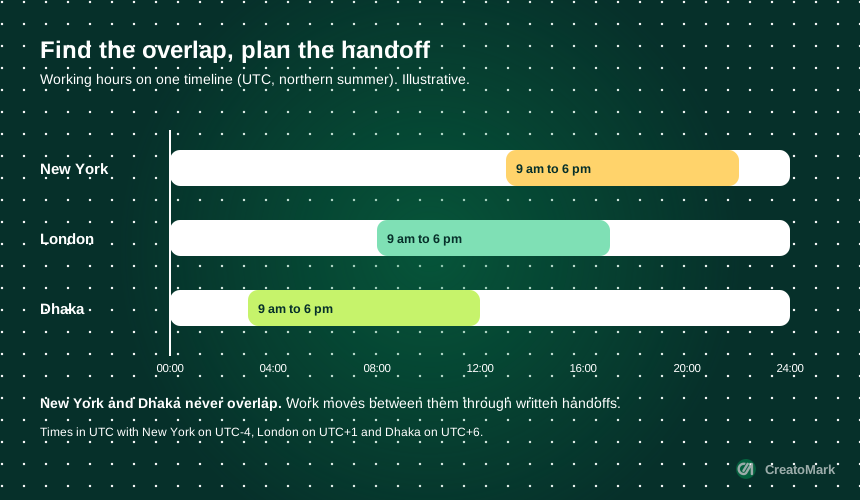
Put everyone’s working hours on one timeline. A free tool like the timeanddate.com meeting planner makes this quick. You’ll find one of three situations:
| Overlap | What it means | How to work |
|---|---|---|
| 4 hours or more | Close enough to work almost like one office | Keep live calls inside the overlap, use the rest for focus time |
| 1 to 3 hours | A narrow window that fills up fast | Reserve it for decisions and blockers only. Everything else goes async |
| None | You will rarely be online together | Run on written handoffs, and meet only occasionally, at rotating times |
Protect the overlap. Don’t let it fill up with status meetings. Status can be written. The overlap is for the conversations that can’t: decisions, problems and anything a client is waiting on.
Step 2: make meetings fewer, fairer and recorded
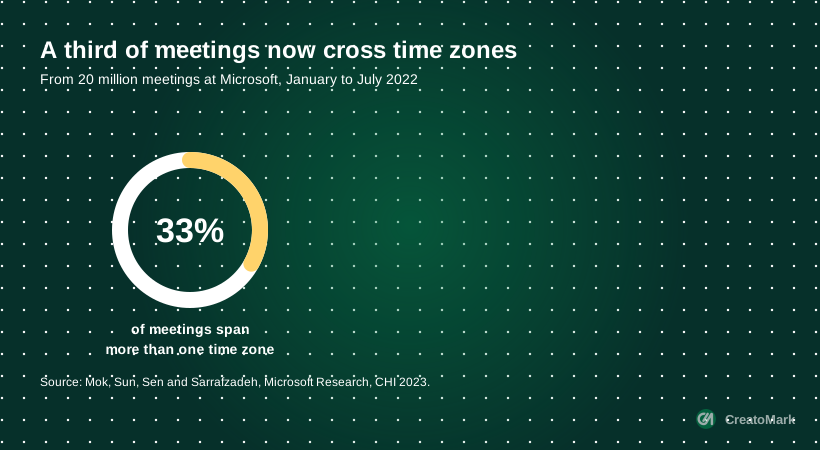
A Microsoft Research study of 20 million meetings, published at the CHI 2023 conference, found that a third of meetings had attendees in different time zones. Those meetings had 36% more attendees on average and were pushed into early mornings and late evenings, even though people strongly preferred to meet between 8 am and 6 pm.
The study also found the burden was uneven: a minority of employees in each location took on most of the cross time zone meetings. In a small agency, that minority is usually you, or your one most senior person.
Other research points the same way. A study of 12,038 employees at a large multinational, published in Organization Science in 2024, found that bigger time differences cut live, synchronous communication and pushed people to shift their working day to reach colleagues. Microsoft’s Work Trend Index reported meetings starting after 8 pm up 16% in a year.
Meetings that wear people out
Meetings that work across zones
Step 3: hand work over like a relay team
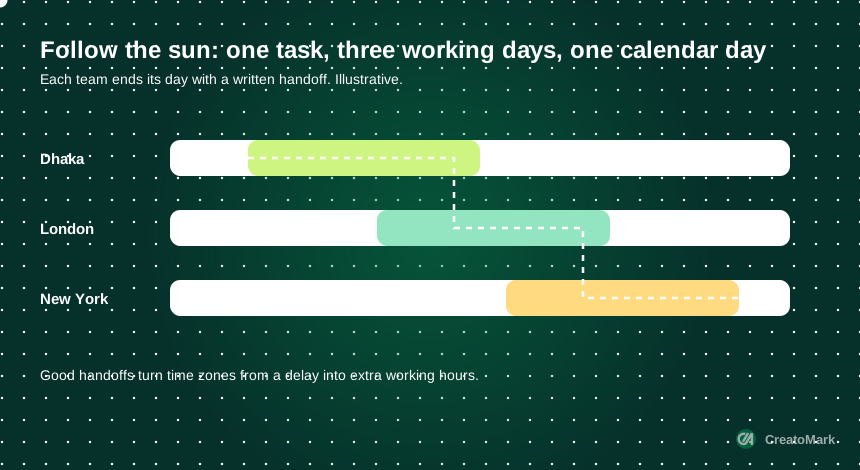
When teams don’t overlap, the handoff note is the meeting. A good one takes five minutes to write and saves hours of waiting. A bad one, or none at all, means the next person spends their morning working out where things stand.
A handoff note that works
Keep handoff notes in the project, not in private chats, so anyone can pick up the thread. The same habit is at the heart of our guide to running your agency remotely.
Step 4: make expectations impossible to miss
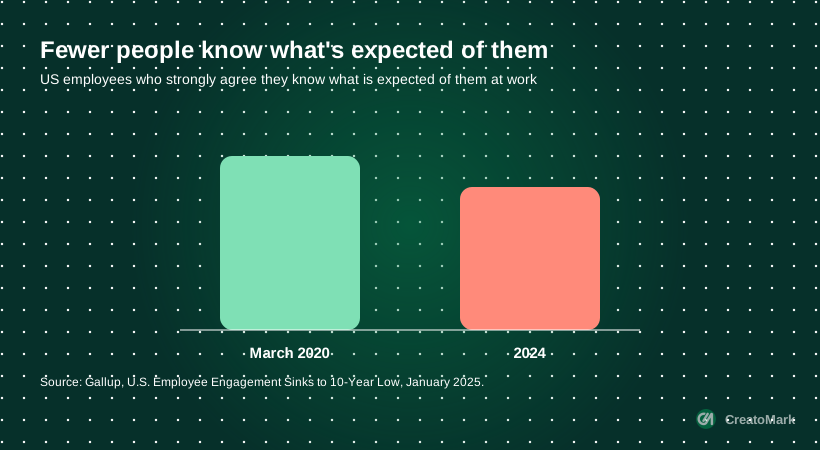
Gallup found that just 46% of US employees clearly know what is expected of them at work, down from 56% in March 2020. In a remote team that’s even more costly. You can’t glance across the room to see that someone is working on the wrong thing.
Across time zones, write expectations down at three levels:
| Level | Write down | Example |
|---|---|---|
| Role | What the person owns and how success is measured | Owns front-end builds; pages pass the QA checklist first time |
| Week | Their top three outcomes for the week | Finish the product page, fix two care plan tickets, start the blog template |
| Task | Done means what, by when, checked by whom | Mobile layout matches the design, live by Thursday, checked by the project lead |
Notice what isn’t on that list: hours online. Across time zones, judge outcomes, not activity. Someone who is green on chat all day isn’t necessarily delivering, and someone who works quietly in a different window may be your best person.
Step 5: the manager makes or breaks it
Gallup estimates that managers account for at least 70% of the variation in engagement between teams. In a small agency, the manager is often you. That’s good news: a few habits make a big difference.

Twenty minutes every two weeks, held in their working hours, not yours.
Answer blockers before the person’s next working day starts, even if everything else waits.
Praise good work in the team channel, so people in other zones see it too.
No messages that expect replies outside someone’s hours. Schedule them to send in their morning.
Mistakes that make time zones painful
If the same people always join at 10 pm, you’ll lose them. Rotate.
If it isn’t written down, the people asleep during the call never got the decision.
Tell clients your reply times and who covers which hours, so silence never looks like neglect.
Use time zones as an advantage
For an agency, a partner in a different time zone can be a real advantage. Work briefed at the end of your day can be done by the time you’re back, and your clients see progress every morning. That only works with the habits above: clear briefs, written handoffs and agreed reply times.
CreatoMark is a hybrid team working across the US and Bangladesh, and we reply to partners within one business day. As a white-label partner, we deliver WordPress development and website care plans under your brand. Before you choose any partner, read how to choose a white-label partner, and compare the costs in white-label vs hiring.
Want work that moves while you sleep? Book a growth call and we’ll map out a handoff rhythm that fits your hours, or compare plans on our pricing table.
The bottom line
Time zones don’t break remote teams. Unclear handoffs, unfair meetings and invisible expectations do. Find your overlap and protect it, write every handoff, rotate the hard meeting slots and judge people by what they deliver.
Do that, and the hours your team doesn’t share stop being a delay. They become extra time on every project, and fewer late nights for you. Then check the results each week with the 7 numbers every agency owner should track.