


Nobody left. Every client is still on the books. Every monthly call still happens. And yet, somehow, revenue is lower than it was a year ago.
If that sounds familiar, you’re probably looking at soft churn: clients who don’t fire you, they just quietly pay you less. “Let’s pause the blog for a bit.” “We’ll handle the social captions ourselves.” “Can we drop the monthly report to quarterly?” Each request sounds small and reasonable. Together, they can wipe out a quarter of an account.
In this article
Soft churn, by the numbers
Gartner’s 2025 CMO Spend Survey also found that marketing budgets have flatlined at 7.7% of company revenue. Flat budgets plus new AI tools is exactly the mix that produces soft churn: clients don’t have more money, so they look for things to take back in-house.
What soft churn looks like
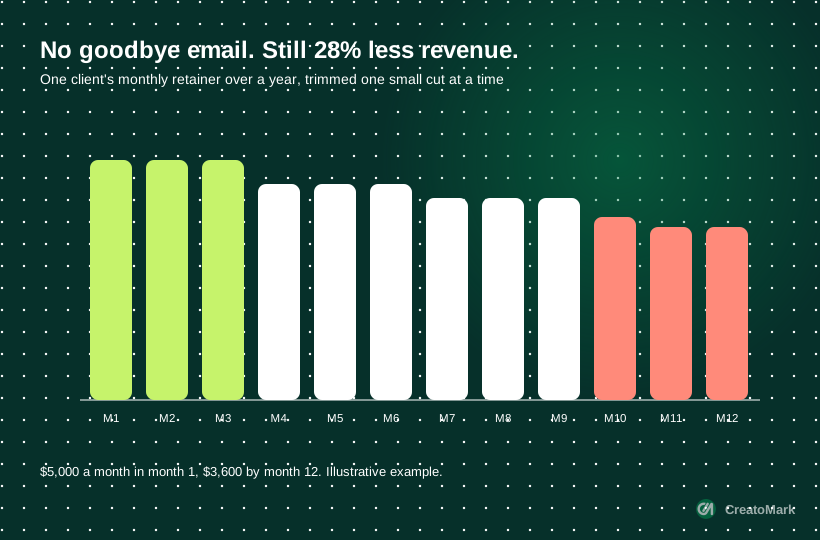
It’s easy to miss because each step is small. A paused service here, a lighter report there. No single cut feels worth a fight. But after a year, the account is a very different size, and your team’s time is often still spread across it as if nothing changed.
Why it’s happening now
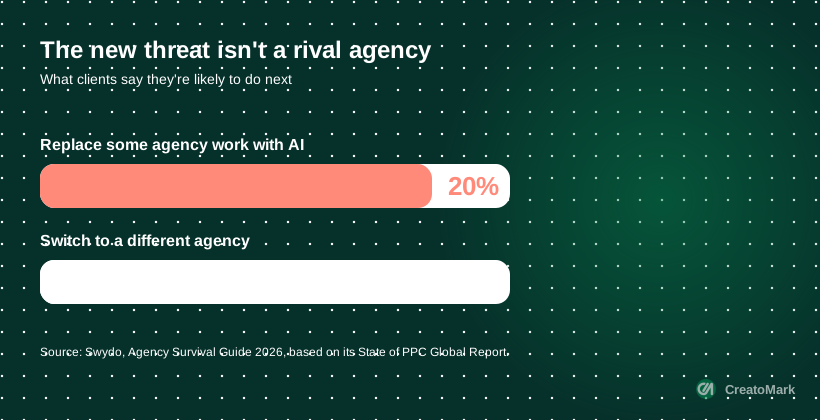
Swydo’s Agency Survival Guide puts it plainly: more clients plan to replace some agency work with AI than to switch to a different agency. The competition isn’t only the agency down the road anymore. It’s the AI tool your client opened last Tuesday.
Content, captions and simple edits feel easy to move in-house with a new tool.
With budgets stuck, every line in your invoice gets questioned at renewal time.
If a service has no clear result attached, it’s the first one to go.
The number that exposes soft churn
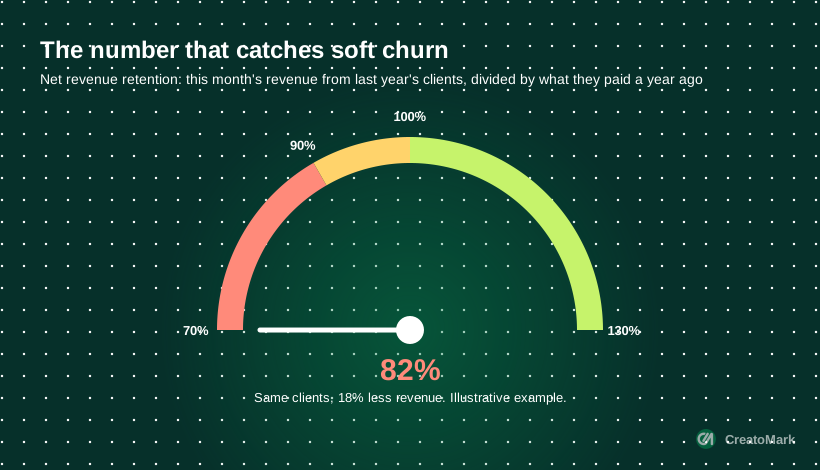
Most agencies track client churn: how many clients left. That number can look perfect while revenue drains away. The number you need is net revenue retention (NRR).
| How to work it out | Example |
|---|---|
| Take the monthly revenue from the clients you had 12 months ago | 20 clients paid $60,000 a month a year ago |
| Add up what those same clients pay you today (ignore new clients) | The same 18 still with you now pay $49,200 |
| Divide today by a year ago | $49,200 ÷ $60,000 = 82% NRR |
Rule of thumb: under 90% means you’re leaking revenue, even if few clients left. 100% or more means your existing clients are growing with you. Check it every quarter.
Seven warning signs
Watch for these every month
One sign on its own isn’t a crisis. Two or three in the same quarter means it’s time for a proper conversation. Many of the same signals show up before clients leave altogether, as we covered in Why Clients Really Leave Agencies.
When a client asks to cut scope
Reactions that make it worse
Reactions that protect the account
A scope cut is a question, not a decision: “Is this still worth it?” Answer with results, not resistance.
If the cut is because “we’ll do it with AI now”, use the four-step answer from Your Client Says “We’ll Just Use AI Now.”. Often the right move is to stay involved as the team that sets up, checks and publishes what their AI tools produce.
How to win the scope back
01
Tie every service to a result
If a line on the invoice can’t point to an outcome, fix that before the client asks about it.
02
Lead reports with value
CallRail’s research found agencies not proving ROI had the shortest client relationships. Start every report with the headline result.
03
Bring a growth idea each quarter
A specific proposal: a landing page test, a new campaign, an automation. Expansion starts with an idea.
04
Move up to higher-value work
Convert found that of agencies that raised prices, 72% did it by moving to higher-value work. Trade routine tasks for strategy and results.

Make it cheaper to keep you than to cut you
Here’s the honest reason many scope cuts happen: the client thinks they can do it cheaper themselves, and for simple tasks, sometimes they can. Your answer isn’t to compete on price. It’s to make the work you keep so clearly valuable that cutting it feels risky.
That’s easier when delivery is fast and dependable. A white-label partner can take on the production work behind your brand, so your team has time for the strategy, ideas and reporting that keep accounts growing. And retainers built on ongoing services like care plans and SEO are far harder to trim than one-off tasks.
Seeing retainers shrink across your client list? Book a growth call and we’ll look at where to add value back, or compare plans on our pricing table.
The bottom line
Soft churn doesn’t announce itself. It shows up as a slightly smaller invoice, then another, until a healthy-looking client list is quietly earning much less.
Track net revenue retention, watch for the warning signs, and answer every scope cut with results and a better offer. Do that, and the clients who stay will grow with you instead of shrinking away.