


If winning new clients feels harder than it did two years ago, you’re not imagining it.
A business owner who once would have called an agency now opens an AI builder on a Sunday evening, types a few sentences and has a homepage before dinner. Why pay for a website when you can make one yourself?
It’s easy to see that as the end of agency work. We think it’s the opposite. The work hasn’t disappeared. It has moved further down the road, and the agencies that understand where it moved to are going to do very well.
The short version: AI tools are great at starting websites and apps, and much weaker at finishing, securing and growing them. Stop competing with the tool on “making a first version”. Sell everything that comes after it.
How big this shift really is
To get a sense of scale: AI app builder Lovable reported reaching $100 million in annual recurring revenue just eight months after launch, with millions of users and more than 10 million projects created. Those are company-reported figures, but the direction is unmistakable.
Small businesses are on board too. The US Chamber of Commerce found that 58% of small businesses now use generative AI, more than double the share in 2023.
So yes, a lot of first versions are being built without an agency. The question is what happens next.
Where clients get stuck
Here’s the pattern we see again and again. The first 80% happens in a weekend. The last 20% takes months, or never happens at all.
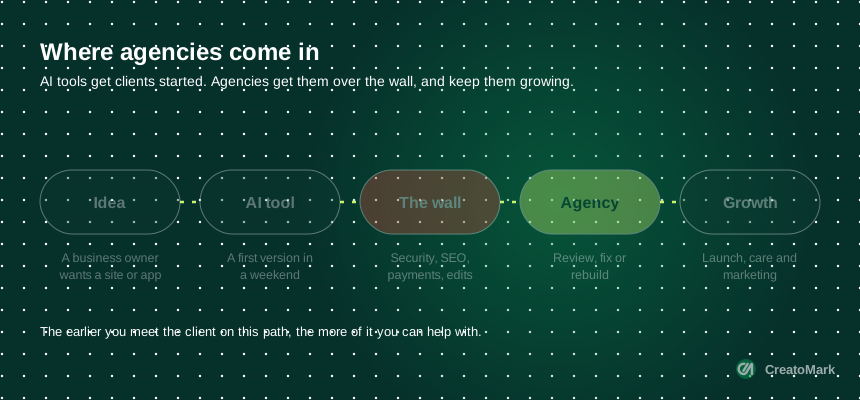
“The wall” usually looks like one of these:
- It isn’t safe. In Veracode’s testing, AI-generated code introduced a security flaw in 45% of tasks. Most business owners have no way to spot that.
- Google can’t find it. No proper page titles, content that only appears after scripts run, no sitemap.
- Nobody can edit it. Changing a price means going back into the AI tool and hoping it doesn’t break something else.
- It can’t grow. Adding a shop, bookings, a member area or a blog turns into a tangle.
- It’s “almost right”. Even developers find AI output is often almost right but not quite. For a non-technical owner, that last bit is where they give up.
Every one of those is a problem an agency solves. The client has already shown they want a website and are willing to invest time in it. They’re not a lost lead. They’re a warm one.
Five services for clients who start with AI
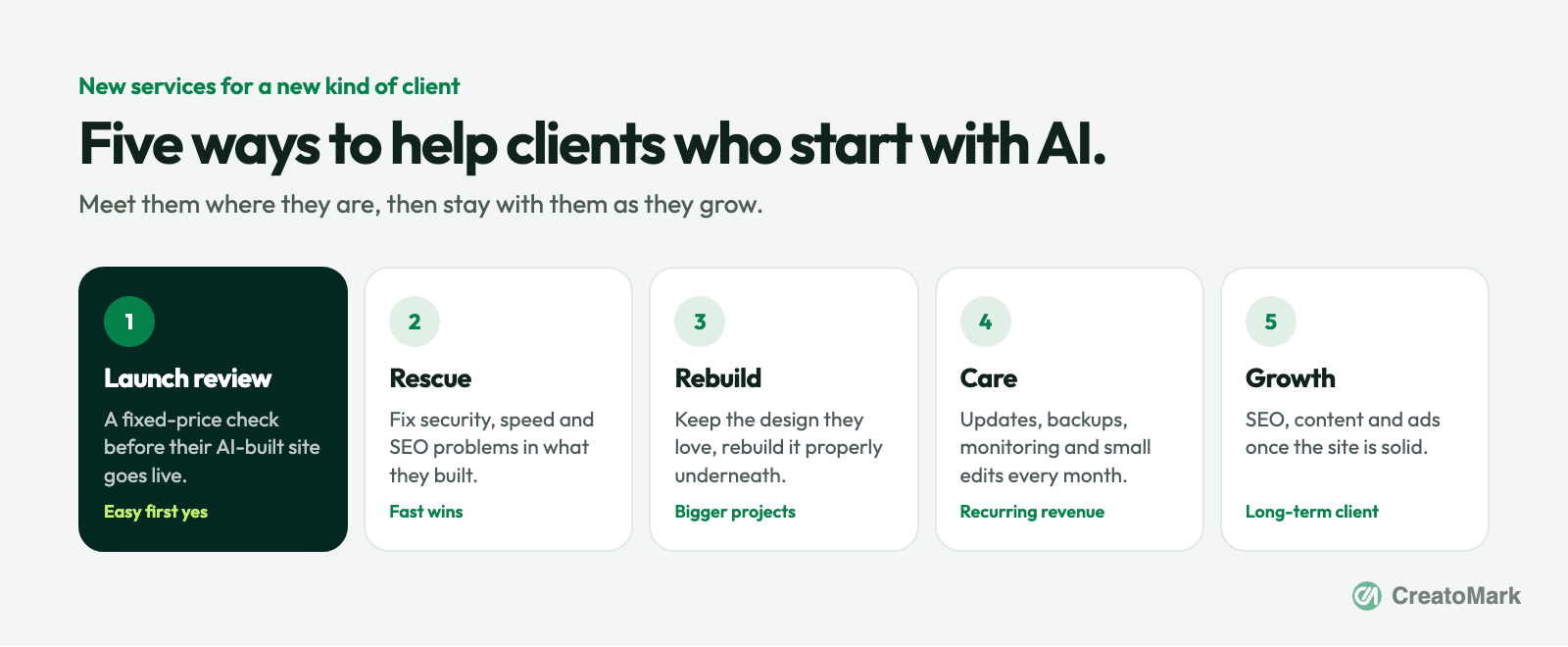
1. A launch review
A fixed-price check before their site goes live: security, speed, SEO and accessibility, with a clear one-page report. It’s a small, easy yes, and it opens the door to everything else. We cover how to run it in Your Client Built a Site with an AI Tool. Now What?.
2. A rescue
Fix the specific problems the review found and get the site live properly. Fast, tangible wins that build trust quickly.
3. A rebuild that keeps what they love
When the foundations aren’t worth saving, keep the design and content the client is proud of, and rebuild underneath on a platform they can edit, like WordPress or Webflow. The AI-built version becomes the clearest brief you’ll ever get.
4. Care
Updates, backups, security checks and small edits every month through a care plan. AI tools don’t look after a website once it’s live. You can.
5. Growth
Once the site is solid, help it earn its keep with SEO, content and paid ads. This is where a one-off job becomes a long relationship.
How to position your agency now
The agencies struggling most are still selling “we’ll build you a website” as their main offer. That’s the one part AI has made cheap. Instead, try leading with outcomes the tool can’t promise:
| Instead of selling | Sell this |
|---|---|
| A new website | A website that’s safe, found on Google and brings in leads |
| Design and build | Launch, care and growth, one partner for all of it |
| A project | A monthly service that keeps improving results |
| Competing with AI tools | Finishing what the AI tool started |
And don’t be shy about it. Say it plainly on your website and in proposals: “Started your site with an AI builder? We’ll check it, finish it and help it grow.” You’ll be surprised how many people are quietly looking for exactly that.
Where to find these clients
- Your own enquiries. Leads who said “we’re doing it ourselves” a few months ago. Check in. Many are stuck.
- Communities and groups where small business owners share what they’ve built and ask for help.
- Your existing clients’ side projects, new locations and new business ideas they’re testing with AI tools.
- Your content. Articles like this one, answering the exact questions people ask once they hit the wall.
Delivering it without growing your payroll
Rescues and rebuilds arrive at random, need a mix of skills and are hard to plan around. That’s exactly where a white-label partner helps. You own the client relationship and the pricing. Your partner handles the audits, fixes and rebuilds behind your brand. If you’re weighing that against hiring, our breakdown of what a new developer really costs is a good place to start.
Getting enquiries from clients who started with AI? Book a growth call and we’ll help you shape these five services for your agency.
The bottom line
AI tools have made it easy to start a website. They haven’t made it easy to finish one, secure it, run it or grow it. That’s still skilled work, and it’s still worth paying for.
So stop competing with the tool. Meet clients at the wall, help them over it and stay with them on the other side. That’s how agencies keep winning, even when the client builds the first version themselves.