


It usually comes up near the end of a call. “We’ve been playing with AI a lot. We’ll probably just handle the content and the small website stuff ourselves now.”
Your stomach drops a little. Is this the start of the end? Should you push back, drop your price, or just say “sure” and hope for the best?
None of those, as it turns out. This conversation is happening in agencies everywhere right now, and the ones that handle it well often come out with a stronger client, not a smaller one. It’s the same shift we cover in Clients Are Building Their Own Websites with AI. Here’s how.
In this article
You’re not the only one hearing this
Look at those numbers together. Clients are pulling some work in-house, and budgets are being trimmed. But the share of business owners who actually finish the job on their own hasn’t moved.
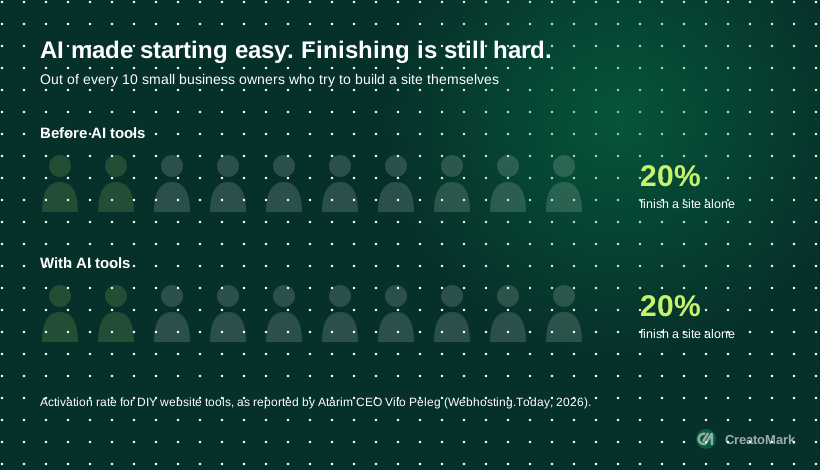
In an interview with Webhosting.Today, Atarim CEO Vito Peleg put it simply: the activation rate for small business owners using DIY website tools was around 20% before AI, and it’s still around 20% with AI. Eight in ten still can’t get it done alone. He also mentioned people who moved their site to an AI builder and moved back to WordPress within three months.
Why clients really say it
“We’ll just use AI” is rarely about AI. Underneath, it’s usually one of these:
Budgets are tight and AI looks like a quick saving. Usually the real question is “can we pay less?”
Small edits take days through you. With AI, they imagine doing them in minutes.
They tried a tool, it impressed them, and they want to see how far it goes.
Sometimes it’s a polite way of saying the value isn’t clear anymore.
Your answer depends on which one it is, so ask before you answer. If it’s the last one, read our guide on why clients really leave agencies first.
What not to say
Avoid these
Say this instead
The four-step answer
01
Agree with what’s true
AI really is good at drafts, ideas and repetitive edits. Saying so builds trust and takes the tension out of the room.
02
Ask which parts
Get specific: which tasks, how often, who on their team will do them. Vague plans are where things go wrong later.
03
Show where it stalls
Gently point out the parts that need an expert: quality, security, launch, results. Use real examples, not fear.
04
Offer a new shape
Propose a version of your service where they use AI for the quick stuff and you run, check and improve everything else.
Where AI really helps, and where it stalls
You’ll be more convincing with facts than opinions. A few worth knowing:
| Task | AI on its own | What the research says |
|---|---|---|
| First drafts and ideas | Strong | Fast and useful as a starting point |
| Code that “works” | Mixed | 66% of developers say AI output is often “almost right, but not quite” |
| Security | Weak | Veracode found a security flaw in 45% of AI coding tasks |
| Real-world speed | Mixed | METR found experienced developers were 19% slower with AI on real work |
| Customer-facing answers | Risky | A tribunal held Air Canada liable for its chatbot’s wrong answer |
Words you can borrow
Here’s a reply that works for most clients. Adjust it to your voice:
“That makes a lot of sense. These tools are great for drafts and quick edits, and we use them ourselves. Let’s agree which parts your team will handle, and we’ll set those up properly so the quality stays where your customers expect it. We’ll keep running and checking everything that goes live, and focus our time on the work that grows the business. I’ll send over a new scope this week.”
Notice what it does. It agrees, it gets specific, it keeps you in charge of quality and results, and it ends with a clear next step. No fear, no discount, no drift.
Turn it into a new offer
This is the part most agencies miss. A client who wants to use AI is a client who wants something new. Give them a package built around it:
Set up the tools, write the prompts and brand rules, and train their team in a single session.
They draft with AI. You check facts, brand, SEO and accessibility before anything goes live.
Your team focuses on SEO, campaigns and conversion, the work that moves numbers.
You might even sell them AI chatbots and automations they didn’t know they wanted. And if their AI experiments leave them with a half-finished site, you already know what to do next.

Price the change, don’t just shrink the retainer
If some tasks move to the client, the scope changes. But don’t simply cut the price by the hours you lose. Re-shape the retainer around higher-value work instead:
Old retainer
New retainer
In Convert’s 2026 agency research, 81% of agencies raised or held their rates this year, and of those that raised prices, 72% did it by moving to higher-value work. Use this moment to make that move.
Deliver the new model without hiring
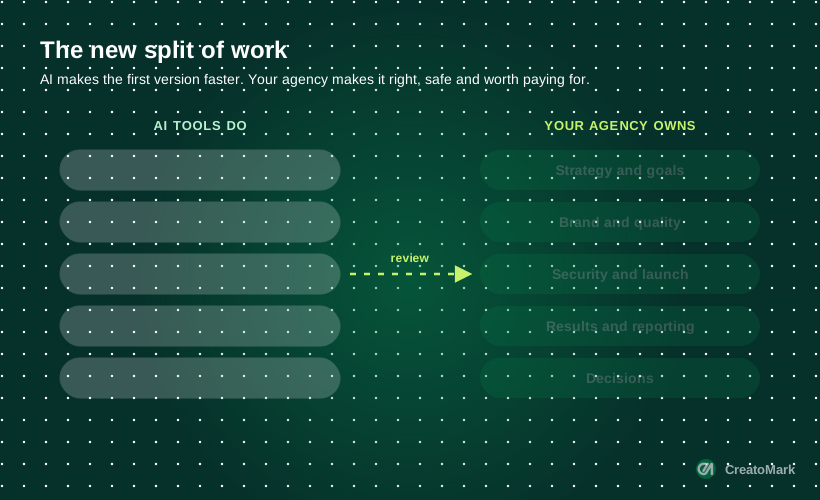
The new shape needs more expert review, more strategy and faster turnaround on fixes. A white-label partner whose team already uses AI day to day can take on the production and review work under your brand, while you keep the client relationship. See how we use AI in our own workflow in How Agencies Can Use AI to Deliver Faster.
Had the “we’ll just use AI” conversation recently? Book a growth call and we’ll help you re-shape the offer, or compare plans on our pricing table.
Before your next client call
The bottom line
“We’ll just use AI now” sounds like the start of a goodbye. Handled well, it’s the start of a better deal: your client gets speed and savings on the simple work, and you get to focus on the work that’s worth paying for.
Agree, ask, show, offer. Then send the new scope before the week is out.